


Introduction and Strategic Context
The history of the Aston Martin Vantage V8, which began in 2005, represents the most crucial chapter in the modern survival of the British manufacturer. Before this launch, Aston Martin operated as a very low-volume automotive "boutique", focused on heavy, hand-built Grand Tourers (GTs) at the old Newport Pagnell factory, such as the V8 models of the 70s and 80s and, later, the Vanquish. Although prestigious, these vehicles did not generate the cash flow necessary to guarantee the brand's financial independence and technological development in the 21st century.
Under the ownership of Ford (part of the Premier Automotive Group), Aston Martin needed a product that could compete not only in prestige, but in volume and dynamic capability, with the absolute benchmark of the sports car segment: the Porsche 911. The goal was not just to sell cars, but to democratize the Aston Martin experience without diluting the brand's exclusivity. The result of this strategic imperative was the AMV8 Vantage project.
The VH Architecture: Aerospace Innovation
The technical foundation that allowed the existence of the V8 Vantage was the VH (Vertical/Horizontal) platform. Unlike traditional tubular chassis or steel monocoques, the VH architecture used an aluminum extrusion and bonding technique derived from the aerospace industry.
The central innovation lay in the joining method. Instead of welding the aluminum parts, which could introduce heat and deformations, or using only rivets, Aston Martin utilized high-strength, thermally cured epoxy adhesives. This technique resulted in a structure with exceptional torsional rigidity, essential for a sports car that needed cornering precision, while keeping the weight low. The Vantage's chassis was not just a shortened version of the DB9; although they shared the VH philosophy, the Vantage used unique components and a significantly shorter wheelbase (2,600 mm) to ensure superior agility, moving away from the "road GT" behavior of its larger sibling.
Design Philosophy: The Golden Ratio
The design, led by Henrik Fisker, is widely considered one of the most beautiful in modern automotive history. The Vantage was designed with minimal front and rear overhangs and a high, muscular beltline. The absence of protruding bumpers (integrated into the bodywork) and the compact silhouette gave the car the appearance of a "crouching predator". At 4.38 meters long, it was purposely compact — 34 mm shorter than a Porsche 911 (997) and 284 mm shorter than the DB11 that would come later — which made it easier to position the car on winding roads and tracks.
VH Generation, Phase 1: The 4.3 Liter V8 (2005 – 2008)
AM05 Engine Engineering
The heart of the first modern V8 Vantage was the 4.3-liter (4280 cc) engine, internally designated as AM05. The origin of this engine is often debated. Although the basic architecture of the block was shared with Jaguar (the AJ-V8 design), Aston Martin made such extensive modifications that it considered it an exclusive engine.
Shutterstock ExplorarThe main technical difference to any Jaguar cousin was the lubrication system. Aston Martin implemented a dry sump system. In conventional wet sump engines, the oil is stored in a reservoir at the base of the engine. In the dry sump, the oil is pumped to an external reservoir. This offers two critical advantages for a sports car:
- Center of Gravity: Without the bulky oil reservoir at the base, the engine could be mounted much lower in the chassis, improving stability and steering response.
- Track Reliability: The system ensures that the engine receives constant lubrication even under extreme lateral G-forces in corners, where oil in a wet sump could slosh and leave the oil pump "dry".
The engine was hand-assembled at Aston Martin's engine plant in Cologne, Germany. It produced 380 PS (283 kW) at 7,300 rpm and 410 Nm (302 lb-ft) of torque at 5,000 rpm. The power delivery was linear and progressive, typical of high-revving naturally aspirated engines, requiring the driver to work the gears to extract maximum performance.
Transaxle Transmission and Dynamics
To achieve optimal weight distribution, Aston Martin used a transaxle layout. The engine was in the front (behind the front axle, configuring a "front-mid engine"), but the gearbox was mounted on the rear axle. The connection between the engine and the gearbox was made by an aluminum torque tube containing a carbon fiber driveshaft, an exotic piece of engineering that ensured power transfer without losses or twisting.
In the early years (2005-2006), the Vantage was offered exclusively with a 6-speed manual transmission supplied by Graziano. This decision reinforced the Vantage's image as a pure "driver's car", in contrast to the automatic models of the competition that focused more on comfort. The resulting weight distribution was 49:51 (front/rear), creating a neutral balance that facilitated control at the limits of grip.
Interior Details and the "ECU"
The interior of the 2005 Vantage set the standard for the brand for the next decade. The highlight was the "waterfall" center console, which flowed smoothly from the dashboard down to the transmission tunnel. The materials were authentic: what looked like metal was metal (often magnesium or aluminum), and what looked like leather was high-quality leather (Bridge of Weir).
A curious and innovative detail was the car key, introduced in subsequent models but conceptualized in this era. Called the "Emotion Control Unit" (ECU), it was made of sapphire crystal and stainless steel. To start the car, the driver inserted the ECU into a slot in the center of the dashboard, which pulsed in red (a "heartbeat") prior to ignition.
The instrument dials were also unique: the tachometer spun counter-clockwise, mirroring the speedometer. While aesthetically pleasing and symmetrical, this feature was criticized by some purists regarding legibility.
| Specification | Value |
|---|---|
| Engine | 4.3L Naturally Aspirated V8 (AM05) |
| Power | 380 cv @ 7,300 rpm |
| Torque | 410 Nm @ 5,000 rpm |
| 0-100 km/h | 4.9 seconds |
| Top Speed | 280 km/h (175 mph) |
| Weight | ~1,570 kg |
The performance, while respectable, was the main point of initial criticism. Compared to the Porsche 911 Carrera S of the time, the Vantage was slightly slower and heavier, and the engine needed to be pushed to the limit to keep up the pace, due to maximum torque only arriving at 5,000 rpm.
VH Generation, Phase 2: The 4.7 Liter Update (2008 – 2011)
In mid-2008, Aston Martin responded to criticisms about the lack of low-end torque with a comprehensive mechanical update. This was not just a "facelift", but a fundamental re-engineering of the powertrain.
The New 4.7 Liter Engine: Technical Evolution
To increase displacement from 4.3 to 4.7 liters (4735 cc), Aston Martin couldn't simply bore out the block, as it was limited by the physical space in the engine bay and the architecture of the block. The solution was ingenious:
- Cylinder Liners: In the 4.3 model, the liners were cast directly into the block. In the new 4.7, Aston Martin began using steel liners pressed into the pre-machined block. This allowed the use of thinner cylinder walls, making it possible to increase the bore from 89mm to 91mm without altering the external dimensions of the engine.
- Stroke: The piston stroke was also increased from 86mm to 91mm through a new forged steel crankshaft. This crankshaft featured holes in the counterweights to reduce rotational mass, improving throttle response and allowing the engine to rev more freely.
- Cylinder Head and Intake: The intake valves were enlarged and the intake manifold modified to improve airflow at high revolutions.
The result was a power increase to 426 PS (420 bhp) — an 11% gain — and, more importantly, a 15% increase in torque, which climbed to 470 Nm. This transformed the drivability of the car, making it much more responsive for overtaking and urban driving, without the constant need for downshifting.
Introduction of Sportshift and Suspension Changes
Along with the larger engine, Aston Martin refined the transmission option. The 6-speed manual gearbox remained (with a lighter clutch and flywheel), but the automated "Sportshift" option received software updates. It is crucial to distinguish this transmission: it was not a conventional automatic with a torque converter, nor a dual-clutch system (DCT). It was a mechanical manual gearbox with electro-hydraulic actuators operating the clutch and gear selection. While it offered fast shifts on the track, it required a learning curve to be operated smoothly in urban traffic (such as lifting off the accelerator during the shift).
The suspension was also recalibrated. The 4.7 model received 11% stiffer springs in the front and 5% in the rear, along with new steering geometry and revised Bilstein dampers to improve initial turn-in response and high-speed stability.
2009 Interior Update
Visually almost identical on the outside (except for the new optional 19-inch wheels), the interior received a much-needed update in 2009. The old and criticized DVD-based navigation system (inherited from Volvo) was replaced by a Hard Disk Drive (HDD) based system with higher resolution graphics and full iPod/USB integration. The center console was redesigned to accommodate new controls and the glass "ECU" became standard across the line.
VH Generation, Phase 3: Vantage S and Special Editions (2011 – 2017)
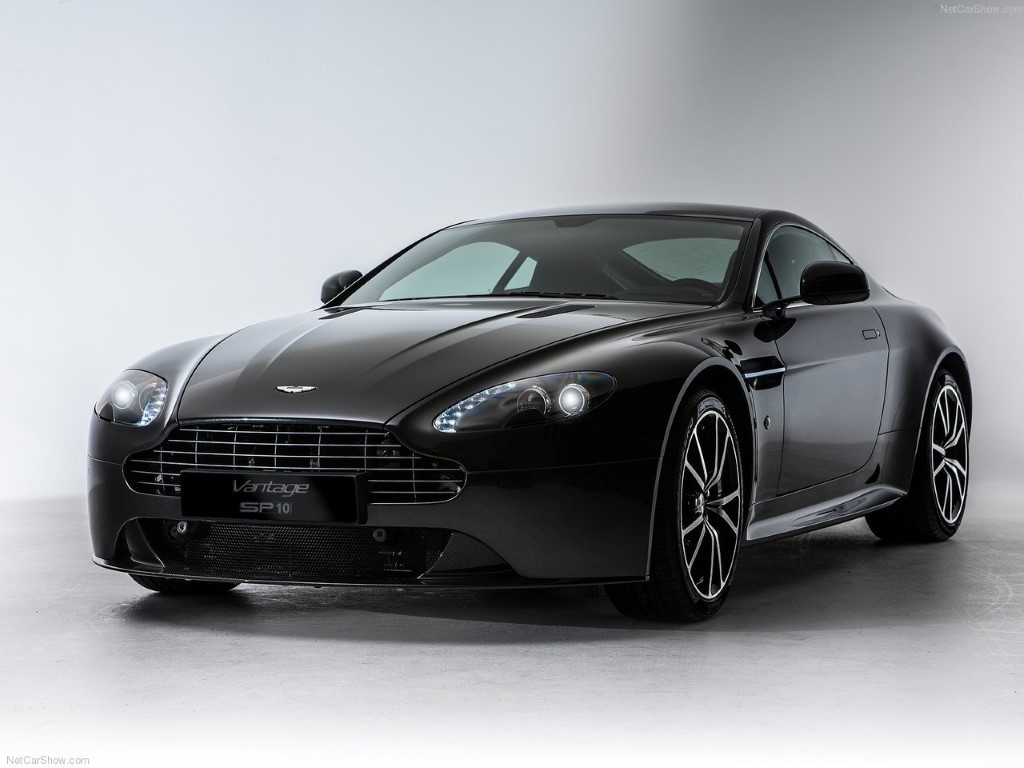
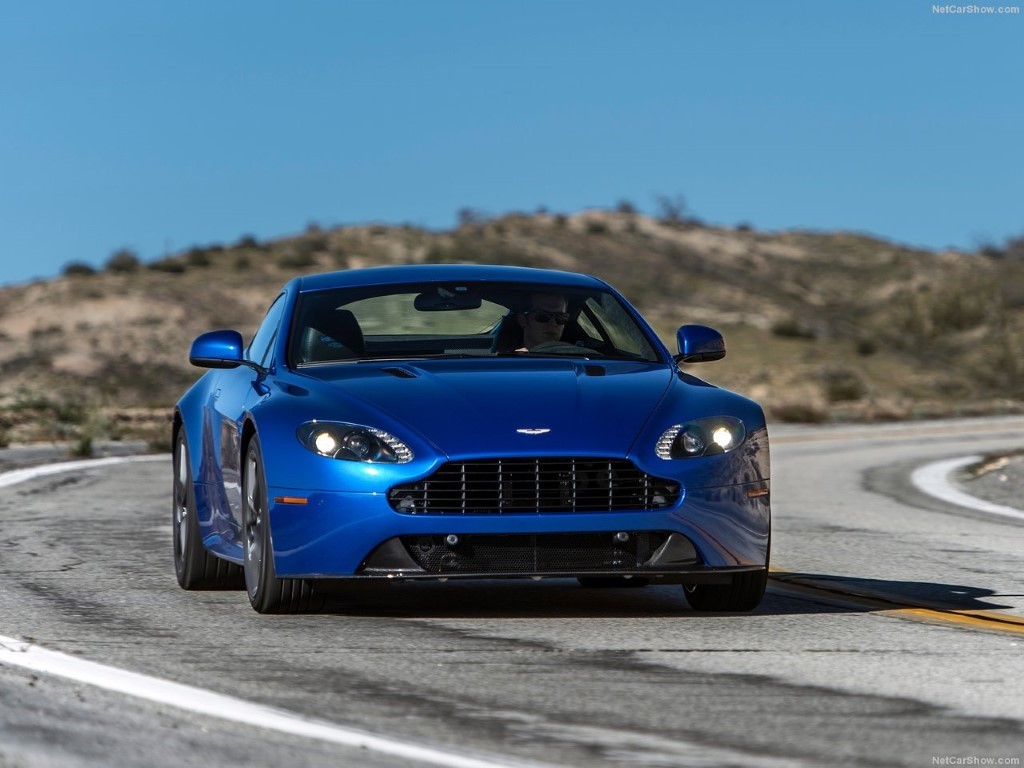
In 2011, Aston Martin launched the V8 Vantage S, a model that signaled the brand's intention to focus more aggressively on track performance and driving dynamics, distancing itself from the soft GT image.
The Vantage S: Technical Differences
The "S" was not just a cosmetic package. It incorporated lessons learned from the V12 Vantage model and the GT4 race cars.
- Optimized Engine: The 4.7-liter V8 received a new ignition mapping and a revised air intake system, raising power to 436 PS (430 bhp) and torque to 490 Nm. The torque curve was broadened, providing more pulling power in the mid-range.
- Sportshift II Transmission (7 Speeds): The greatest innovation of the "S" was the introduction of the 7-speed Sportshift II transmission. This gearbox was designed specifically for performance. By adding an extra gear, Aston Martin was able to shorten the ratios of the initial gears to improve acceleration, while maintaining a long seventh gear for highway cruising. Furthermore, the gearbox was air-cooled (instead of oil), which saved weight. In total, the transmission was 24 kg lighter than the previous 6-speed unit.
- Steering and Brakes: The steering ratio was made more direct (15:1 against 17:1), making the car feel more "nervous" and agile. The front brakes grew to 380mm discs with 6-piston calipers, ensuring resistance to fade under heavy use.
The Consolidation of the Lineup (2012 onwards)
The success of the Vantage S modifications was so evident that, in 2012, Aston Martin applied many of them to the "standard" Vantage. The base model received the quicker steering, the larger brakes, and the option of the 7-speed Sportshift II transmission. This effectively raised the bar for the entire range, making the post-2012 models the most desirable on the used market today for those seeking sharp dynamics.
The Special Editions: The "N" Saga and GT Models
To maintain interest in the model over an exceptionally long production cycle (12 years), Aston Martin launched a series of special editions, many of them paying homage to the brand's test center at the Nürburgring Nordschleife.
- N400 (2007): The first of the series, launched to commemorate the brand's victories at the 24 Hours of Nürburgring. Based on the 4.3L, but tuned to 400 PS. It came standard with the "Sports Pack" (lighter wheels, stiffer springs). Available in exclusive colors like Karussell Orange.
- N420 (2010): Direct successor, now based on the 4.7L 420 PS engine. The focus of this edition was weight reduction. The N420 came with a carbon fiber front splitter, rear diffuser, and seats, saving 27 kg compared to the standard model. It featured extended side skirts and a black finish on the exhaust tailpipes.
- N430 (2014) and Vantage GT: Perhaps the most balanced version in the history of the V8 Vantage. The N430 combined the 436 PS engine from the Vantage S with sports suspension and a racing-inspired look. It offered optional graphic packages with contrasting colors inspired by the legendary DBR1. It was celebrated by the press as the "sweet spot" of the range, offering the best dynamics for the lowest price.
- Vantage GT8 (2017): At the end of the VH platform's life cycle, Aston Martin launched the Vantage GT8, a version limited to just 150 units worldwide. Conceived as a GTE race car for the streets, it had a drastic 100 kg reduction compared to the Vantage S, weighing around 1,510 kg. Offered with both a 6-speed manual and a 7-speed Sportshift II, making it one of the most purist analog track cars of the modern era.
Production Analysis (2005–2017)
The VH generation of the Vantage was the biggest commercial success in Aston Martin's history, transforming the scale of the company. Total production of the Vantage family (including V8, V12, Coupé, and Roadster) on this platform is estimated at around 24,700 units.
| Model | Transmission | Estimated Units (Global) | Rarity Notes |
|---|---|---|---|
| V8 Vantage 4.3 Coupé | Manual | ~6,408 | The most common entry point for beginner collectors. |
| V8 Vantage 4.3 Coupé | Sportshift | ~1,746 | Less desirable due to older gearbox technology. |
| V8 Vantage 4.7 Coupé | Manual | ~1,794 | Significantly rarer than the 4.3, highly sought after. |
| V8 Vantage 4.7 Coupé | Sportshift | ~3,421 | The standard late-phase model. |
| V8 Vantage S Coupé | Manual | ~243 | Extremely rare. Introduced late, highly valued. |
| V8 Vantage S Coupé | Sportshift | ~1,668 | The most common configuration of the S model. |
| GT8 | Manual | ~119 | Most buyers opted for the manual. |
| GT8 | Sportshift | ~36 | Rare variant of the track model. |
| Total VH Platform | (V8 and V12) | ~24,700 | The most successful Aston Martin in history. |
Manual vs. Sportshift: In the US specifically, 3,436 V8 Vantage Coupés were imported (total 2005-2017). The manual transmission maintained a surprisingly high take-rate for the segment, especially in the GT and S models, where enthusiasts sought the "analog" experience.
Generation 2: The AMG Revolution and the Turbo Era (2018 – 2023)
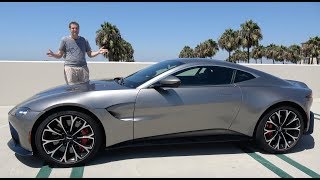
In 2018, Aston Martin ended production of the VH platform and launched an entirely new Vantage. The design, penned by Marek Reichman, broke with classic elegance in favor of predatory aggressiveness, inspired by the car from the movie Spectre (DB10) and the Vulcan track hypercar. Technically, the biggest change was the strategic partnership with Mercedes-AMG.
German Heart, British Soul: The M177 Engine
The most controversial and significant change was the replacement of Aston Martin's naturally aspirated V8 with the 4.0-liter twin-turbo V8 supplied by technical partner Mercedes-AMG.
- Specifications: 510 PS (503 bhp) at 6,000 rpm and 685 Nm (505 lb-ft) of torque available from just 2,000 rpm.
- Character: Aston Martin worked extensively to differentiate this engine from the version used in the Mercedes-AMG GT. British engineers developed exclusive intake and exhaust systems to create a higher-pitched and "technical" sound, avoiding the deep, "American" rumble typical of AMGs.
- Transmission: The Sportshift gearbox was abandoned in favor of the ubiquitous and excellent ZF 8-speed automatic (torque converter). Mounted at the rear (transaxle), it offered smoothness in traffic that the old automated gearbox could never match, with almost instantaneous shifts in sport mode.
The Electronic Differential (E-Diff)
The 2018 Vantage was the first Aston Martin to use an Electronic Rear Differential (E-Diff). Unlike a passive mechanical differential, the E-Diff can go from fully open to 100% locked in milliseconds. Integrated with the stability control system, it allows for torque vectoring, helping the car to "rotate" into corners and increasing agility in a way that mechanical suspension alone could not achieve.
The End of the Manual Gearbox
Initially, CEO Andy Palmer promised that Aston Martin would be the last manufacturer to offer a manual gearbox. In 2019, the Vantage AMR was launched, limited to 200 units, equipped with a 7-speed Graziano manual gearbox with a "dog-leg" layout (first gear down and to the left). This transmission was made available as an option on the standard model the following year.
However, with the change in management and the arrival of Tobias Moers (formerly of AMG), the manual option was canceled. The 2022 facelift marked the definitive end of the manual in the Vantage lineup, citing low sales and the complexity of integration with the new hybrid engines and safety systems.
Vantage F1 Edition (2021)
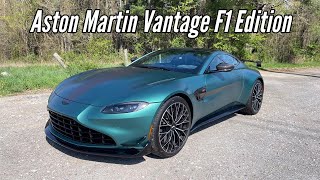
To address criticisms regarding the front suspension of the 2018 model (considered by some to be "vague" on track) and to celebrate the return to Formula 1, the brand launched the F1 Edition. Power increased to 535 PS (528 bhp), introduction of a fixed rear wing and front dive planes generating 200 kg more downforce, and the first Vantages to use 21-inch wheels.
Generation 2, Phase 2: The New "Supercar" Vantage (2024 – Present)
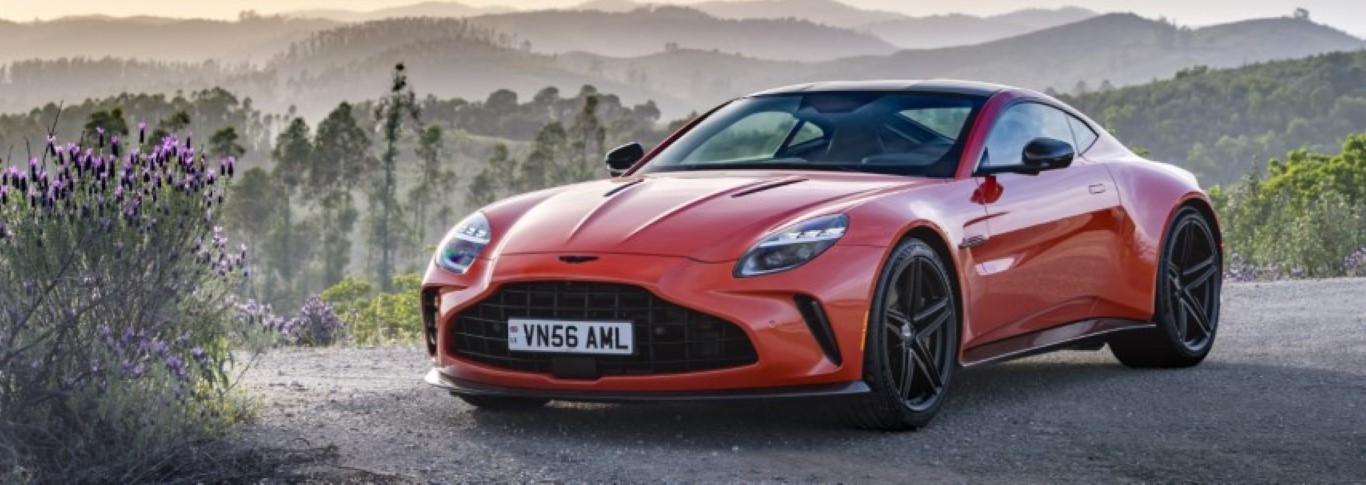
In February 2024, Aston Martin revealed an update to the Vantage so profound that the brand treats it almost like a new model. The goal was clear: to elevate the Vantage from a "sports car" to "supercar" territory, competing directly with the Porsche 911 Turbo S and the McLaren Artura.
Brute Force Engineering: +155 Horsepower
The 4.0L V8 engine received its biggest update to date, distancing itself further from the base Mercedes specification.
- Power: Jumped to an impressive 665 PS (656 bhp) and 800 Nm of torque. This represents a 30% increase in power and 15% in torque over the 2018 model.
- Modifications: Larger turbochargers, new modified camshafts, and optimized compression ratios.
- Cooling: To handle this thermal energy, the cooling system was completely redesigned, with additional radiators and a 38% larger front grille opening, increasing airflow by 50%.
Performance: 0-100 km/h in 3.5 seconds (3.4s for 0-60 mph) and a top speed of 325 km/h (202 mph).
Dynamics and Chassis: Stiffness and Control
The bonded aluminum structure was reinforced with new shear panels and crossmembers, increasing the torsional rigidity of the rear by 29%. This allows the new Bilstein DTX adaptive dampers to work with more precision. These dampers have a 500% greater bandwidth of operation than the previous ones, meaning the car can be simultaneously more comfortable in GT mode and more controlled in Track mode.
The Interior Revolution: Goodbye to the Trackpad
The biggest criticism of the 2018-2023 model was the interior, which utilized an old and frustrating version of the Mercedes infotainment system with a non-intuitive trackpad. The 2024 model completely resolved this.
- New Infotainment: A proprietary Aston Martin system, developed from scratch, with a 10.25-inch touchscreen, ultra-fast response, and wireless integration with Apple CarPlay and Android Auto.
- Physical Ergonomics: Aston Martin rejected the trend of putting all controls on screens. The center console features physical, tactile, knurled metal buttons for critical functions like temperature, fan speed, volume, and exhaust and suspension modes. This allows the driver to operate the car without taking their eyes off the road.
- Materials: The level of luxury was elevated to compete with Bentley, using hand-stitched leathers and high-quality carbon fiber finishes.
| Specification | Vantage V8 (2005) | Vantage V8 S (2011) | Vantage V8 (2018) | Vantage V8 (2024) |
|---|---|---|---|---|
| Engine | 4.3L Naturally Aspirated V8 | 4.7L Naturally Aspirated V8 | 4.0L Twin-Turbo V8 | 4.0L Twin-Turbo V8 (Rev.) |
| Power | 380 PS | 436 PS | 510 PS | 665 PS |
| Torque | 410 Nm | 490 Nm | 685 Nm | 800 Nm |
| 0-100 km/h | 4.9 s | 4.5 s | 3.6 s | 3.5 s |
| Max Speed | 280 km/h | 305 km/h | 314 km/h | 325 km/h |
| Transmission | 6-spd Manual / Sportshift I | 6-spd Manual / Sportshift II | 8-spd Auto (ZF) / 7-spd Manual | 8-spd Auto (ZF) |
Conclusion and Perspective
The Aston Martin Vantage V8 has traveled an extraordinary journey since 2005. What began as a financial rescue mission based on design and mechanical purity evolved into a demonstration of technological strength and brute performance.
For the enthusiast or buyer, each era offers a distinct appeal:
- The Pure Era (2005-2008): The 4.3 manual models are the entry point. While not the fastest, they offer the purest experience, with feedback-rich hydraulic steering and an engine that demands to be explored to the rev limit.
- The Sweet Spot (2012-2017): The Vantage S and N430 models represent the peak of the naturally aspirated platform. Reliable, fast enough for modern roads, and with a soundtrack that turbo engines cannot replicate. They are considered guaranteed future classics.
- The Supercar Era (2018-Present): For those seeking numbers and performance capable of humiliating competitors on the track. The 2024 model, specifically, corrects the ergonomic flaws of the past and delivers a package that finally unites British luxury with cutting-edge technology, justifying its place at the top of the automotive hierarchy.
The survival and continuous success of the Vantage prove that, even in an increasingly digital and electric world, there is still a deep desire for cars that prioritize the thrill of driving, aesthetic beauty, and high-performance mechanical engineering.