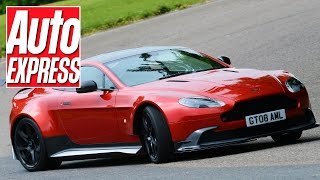
AM05 Engine Engineering
The heart of the first modern V8 Vantage was the 4.3-liter (4280 cc) engine, internally designated as
AM05. The origin of this engine is often debated. Although the basic architecture of the block was shared
with Jaguar (the AJ-V8 design), Aston Martin made such extensive modifications that it considered it an
exclusive engine.
Shutterstock
Explorar
The main technical difference to any Jaguar cousin was the lubrication system. Aston Martin implemented a dry
sump system. In conventional wet sump engines, the oil is stored in a reservoir at the base of the engine.
In the dry sump, the oil is pumped to an external reservoir. This offers two critical advantages for a
sports car:
- Center of Gravity: Without the bulky oil reservoir at the base, the engine
could be mounted much lower in the chassis, improving stability and steering response.
- Track Reliability: The system ensures that the engine receives constant
lubrication even under extreme lateral G-forces in corners, where oil in a wet sump could slosh and
leave the oil pump "dry".
The engine was hand-assembled at Aston Martin's engine plant in Cologne, Germany. It produced 380 PS
(283 kW) at 7,300 rpm and 410 Nm (302 lb-ft) of torque at 5,000 rpm. The power delivery was linear and
progressive, typical of high-revving naturally aspirated engines, requiring the driver to work the gears to
extract maximum performance.
Transaxle Transmission and Dynamics
To achieve optimal weight distribution, Aston Martin used a transaxle layout. The engine was in the front
(behind the front axle, configuring a "front-mid engine"), but the gearbox was mounted on the rear axle. The
connection between the engine and the gearbox was made by an aluminum torque tube containing a carbon fiber
driveshaft, an exotic piece of engineering that ensured power transfer without losses or twisting.
In the early years (2005-2006), the Vantage was offered exclusively with a 6-speed manual
transmission supplied by Graziano. This decision reinforced the Vantage's image as a pure "driver's car", in
contrast to the automatic models of the competition that focused more on comfort. The resulting weight
distribution was 49:51 (front/rear), creating a neutral balance that facilitated control at the limits of
grip.
Interior Details and the "ECU"
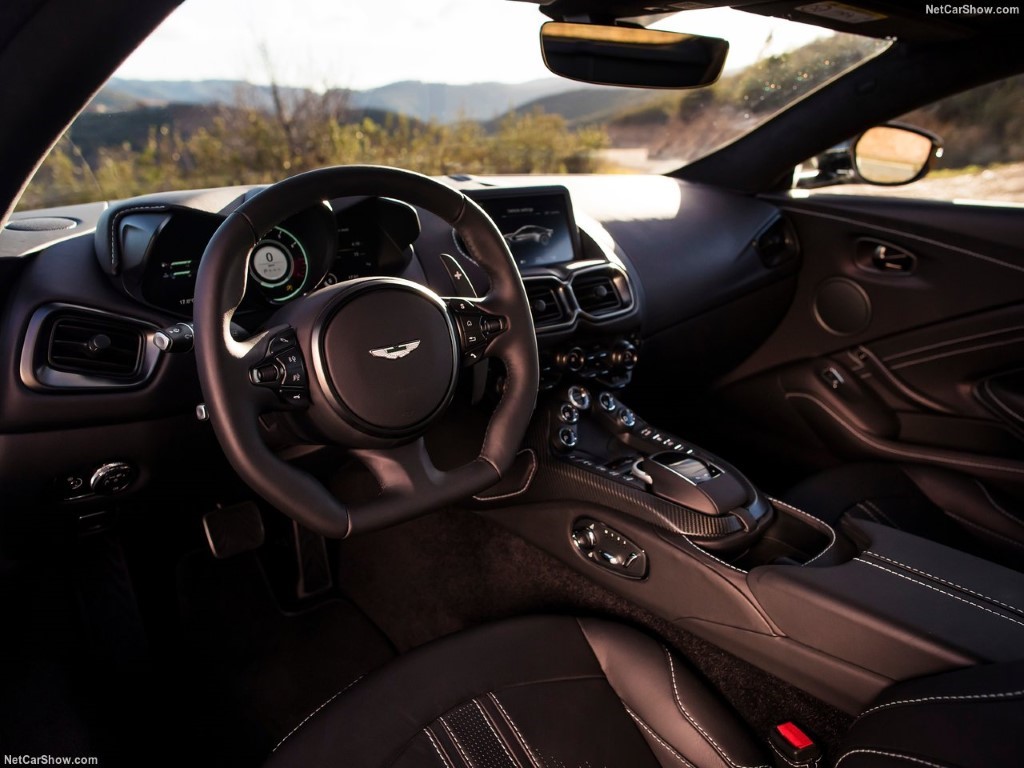
The interior of the 2005 Vantage set the standard for the brand for the next decade. The highlight
was the "waterfall" center console, which flowed smoothly from the dashboard down to the transmission
tunnel. The materials were authentic: what looked like metal was metal (often magnesium or aluminum), and
what looked like leather was high-quality leather (Bridge of Weir).
A curious and innovative detail was the car key, introduced in subsequent models but conceptualized
in this era. Called the "Emotion Control Unit" (ECU), it was made of sapphire crystal and stainless steel.
To start the car, the driver inserted the ECU into a slot in the center of the dashboard, which pulsed in
red (a "heartbeat") prior to ignition.
The instrument dials were also unique: the tachometer spun counter-clockwise, mirroring the
speedometer. While aesthetically pleasing and symmetrical, this feature was criticized by some purists
regarding legibility.
Performance Data (2005)
| Specification |
Value |
| Engine |
4.3L Naturally Aspirated V8 (AM05) |
| Power |
380 PS @ 7,300 rpm |
| Torque |
410 Nm @ 5,000 rpm |
| 0-100 km/h |
4.9 seconds |
| Top Speed |
280 km/h (175 mph) |
| Weight |
~1,570 kg |
The performance, while respectable, was the main point of initial criticism. Compared to the Porsche
911 Carrera S of the time, the Vantage was slightly slower and heavier, and the engine needed to be pushed
to the limit to keep up the pace, due to maximum torque only arriving at 5,000 rpm.