Aston Martin Virage

Aston Martin Virage

The elegance of exclusivity: the missing link between GT comfort and supercar precision.

Aston Martin Virage Generations

Select a generation to see available versions

Aston Martin Virage G1

1st Generation

(1988-1999)

5.3 Twin Supercharged 608 cv
Aston Martin Virage G2

2nd Generation

(2011-2012)

5.9 497 cv

Technical Data and History: Aston Martin Virage

Introduction: The Legacy of Two Eras

Aston Martin's history is often characterized by cycles of financial turbulence followed by periods of stability and technical innovation. Within this corporate narrative, the name "Virage" holds a unique position, serving as the protagonist in two completely distinct chapters of the British manufacturer's saga. The term, derived from the French language meaning "curve" or "change of direction", proved prophetic in both of its incarnations, albeit for divergent reasons.

The first generation of the Virage, launched in the late 1980s, represented the last stand of the "old guard" of Newport Pagnell. It was a vehicle conceived in a transitional era, where handcrafted manufacturing collided with modern homologation requirements and the need for efficiency brought by the brand's acquisition by the Ford Motor Company. This model was not just a replacement for the venerable V8 line that sustained the company for two decades; it was the vehicle that carried Aston Martin through the economic recession of the early 90s, allowing the brand to survive long enough to see its subsequent rebirth with the DB7.

The second generation, introduced in 2011, emerged in a radically different context. Produced at the modern Gaydon factory, this iteration of the Virage was an exercise in niche precision within the company's VH (Vertical-Horizontal) architecture. Designed to fill an almost imperceptible gap between the DB9 Grand Tourer and the aggressive DBS sports car, the 2011 Virage illustrates the challenges of product positioning in the contemporary luxury market. Its ephemeral existence of only 18 months instantly transformed it into a collector's curiosity, a model that, ironically, is rarer than many of its limited predecessors.

This report is dedicated to an exhaustive analysis of both generations, exploring not only the technical specifications and production numbers but also the socioeconomic context, engineering decisions, and design nuances that define the identity of the Aston Martin Virage.

The First Generation (1989–2000)

The Development Context: Project DP2034

To understand the original Virage, it is necessary to revisit Aston Martin's climate in the mid-1980s. Under the charismatic leadership of Victor Gauntlett, the company had regained some stability, but its product line — based on the V8 introduced in 1969 — was hopelessly aging. Emissions regulations, especially in the United States, were strangling the performance of the old carbureted engines, and the "muscular" design of the 70s was going out of style in favor of a more aerodynamic and smooth aesthetic.

The need for a new model was existential. The project, designated internally as DP2034, had a clear mandate: to create a car that was modern enough to take Aston Martin into the 21st century, but that maintained the traditional construction of a separate chassis and hand-formed aluminum bodywork, preserving the brand's artisanal identity.

The Design Competition

The design choice was not trivial. Aston Martin invited five design studios to submit proposals. Unlike the tradition of using Italian coachbuilders like Zagato or Touring, the winning proposal came from a British duo: John Heffernan and Ken Greenley. They were automotive design professors at the Royal College of Art in London.

Heffernan and Greenley's proposal won because it managed to balance modernity with heritage. The design featured clean, flush surfacing, eliminating the rain gutters and prominent chrome bumpers of previous models. However, it maintained the imposing physical "presence" that the brand's customers demanded. The car looked like it had been sculpted from a single block of solid aluminum, a characteristic that would become the model's visual signature.

The official presentation took place at the Birmingham Motor Show in 1988. The reception was enthusiastic, with the press praising the modernization of the classic lines. However, the commercial launch coincided with the collapse of the supercar market and the global recession of the early 90s, which meant that the Virage, destined to be a sales success, became an extremely low-volume product, dependent on ultra-rich and loyal customers.

Engineering and Technical Specifications (1989-1995)

The Virage was the first truly new Aston Martin in almost 20 years. Although it maintained the front-engine, rear-wheel-drive philosophy, the technical execution was significantly updated compared to its predecessor.

The 32-Valve V8 Engine

The heart of the Virage was a profound evolution of the lightweight alloy V8 engine designed by Polish engineer Tadek Marek. However, to meet the new power and emissions requirements, Aston Martin needed outside help.

  • Callaway Development: The company hired Callaway Engineering from Connecticut (USA), famous for their work on twin-turbo Corvettes, to redesign the engine's cylinder heads. The goal was to implement a 4-valve per cylinder configuration (32 valves in total) to improve the engine's "breathing" and combustion efficiency.
  • Fuel Management: The temperamental Weber carburetors, difficult to tune for emissions, were replaced by a modern Weber-Marelli electronic fuel injection system.
  • Final Specifications: The 5,340 cc (5.3 Liters) engine produced 330 bhp (horsepower) at 6,000 rpm and 350 lb-ft (475 Nm) of torque at 3,700 rpm.
  • Catalytic Converters: One of the greatest achievements of this engine was the ability to maintain (and even slightly increase) power compared to previous models, even with the restrictive introduction of mandatory catalytic converters.

Transmission and Drivetrain

The transfer of this power to the rear wheels was managed by two main transmission options, reflecting the car's dual personality as a sports car and grand tourer:

  • 5-Speed ZF Manual: About 40% of early Virages were ordered with this gearbox. It was a robust transmission, but known for having a heavy shift, requiring physical effort from the driver.
  • Chrysler TorqueFlite Automatic: Most buyers (60%) opted for the comfort of the automatic transmission. Initially, the Virage used Chrysler's 3-speed gearbox, an old unit that, although smooth, limited acceleration and fuel economy. In 1993, this was replaced by a more modern 4-speed unit with overdrive, significantly improving high-speed cruising capability.

Chassis and Suspension

The Virage chassis was a steel platform, onto which the aluminum bodywork was attached. The suspension represented a mix of tradition and modernity:

  • Front: Double wishbones with coil springs and an anti-roll bar.
  • Rear: Aston Martin retained the complex and expensive De Dion tube axle, located by radius arms and a Watt's linkage. The De Dion axle is an interesting technical solution that allows the rear wheels to remain vertical to the ground (like a live axle) but without the unsprung weight of the differential (which is fixed to the chassis, like in an independent suspension). This provided excellent traction and comfort on uneven surfaces, ideal for a heavy GT.

Shared Components ("Parts Bin")

To make the production of such a low-volume car viable, Aston Martin resorted to "cannibalizing" parts from major manufacturers, a common practice in the British niche industry.

  • Headlights: Sourced from the Audi 200.
  • Taillights: Originally from the second-generation Volkswagen Scirocco.
  • Steering Column and Controls: Borrowed from Ford and, in some cases, General Motors or Jaguar. Despite these humble origins, the interior finish was unmatched, with hand-stitched Connolly leather and walnut wood covering the dashboard, effectively hiding the plebeian origins of the electrical components.
The Virage Family: Variants and Evolutions

The Virage chassis proved to be extremely adaptable. During the 90s, Aston Martin used this base to create a complete family of vehicles, trying to fulfill every desire of its exclusive clientele.

Virage Volante (1990/1992–1996)

Aston Martin tradition dictates that every coupé must have a convertible counterpart ("Volante"). The Virage Volante debuted at the 1990 Birmingham Motor Show.

  • Development: Originally shown as a two-seater convertible, customer feedback was negative; they wanted space to carry children or extra luggage. Aston Martin redesigned the car to be a 2+2 (four seats) before production began in 1992.
  • Construction: Removing the roof required significant structural reinforcements in the steel chassis to prevent torsion. The roof was a complex piece of engineering, with a mohair headliner and electro-hydraulic operation.
  • Performance: Due to the extra weight of the reinforcements, the Volante was slightly slower than the Coupé, but offered an open-air driving experience unmatched in terms of luxury. The vast majority were sold with an automatic transmission.

The 6.3 Liter Conversion (Works Service)

Shortly after the launch, some customers criticized that the Virage, with 330 hp and weighing almost 1,800 kg, was not fast enough to compete with the supercars of the time. Aston Martin's response did not come from the main production line, but rather from the "Works Service" division.

  • The Engine: The V8 was dismantled and re-machined to increase displacement from 5.3 to 6.3 liters. This resulted in a power jump to around 465 to 500 bhp and massive torque.
  • The Complete Package: The 6.3 conversion was not just about the engine. It included 14-inch ventilated disc brakes (the largest in the world on a passenger car at the time), reworked suspension, and a "wide body" kit with extended wheel arches to accommodate massive Goodyear Eagle tires.
  • Legacy: The look of the Virage 6.3 defined Aston Martin's muscular aesthetic for years to come and served as a visual prototype for the future Vantage.

Shooting Brake and Lagonda: The Eccentricities

The flexibility of manual construction allowed the creation of extremely rare models, often custom-made for royalty.

  • Virage Shooting Brake (1992-1994): A high-performance two-door estate ("Shooting Brake"). Unlike previous conversions done by third parties, these were built by the factory itself. They used the rear tailgate of the Ford Escort Estate and taillights from the Renault 21, masterfully integrated. It is believed that only 6 to 8 units were made.
  • Lagonda Virage Saloon: A four-door version, reviving the Lagonda name. The chassis was lengthened by 12 inches (30 cm). About 8 or 9 units produced.
  • Lagonda Virage Shooting Brake: A five-door estate based on the long-wheelbase Lagonda chassis. Only 1 or 2 units confirmed, making it one of the rarest Aston Martins in history.
The Vantage and the Twilight (1993–2000)

The Vantage (1993–2000): The "Brute in a Suit"

In 1993, Aston Martin decided that the Virage platform needed a dedicated high-performance version, not just aftermarket conversions. The result was the return of the Vantage name. It is crucial to note that, although based on the Virage chassis, this car was marketed simply as the "Aston Martin Vantage", dropping the Virage name to distance itself from the less powerful base model.

Supercar Engineering

The Vantage was a technical tour de force. The goal was to create the most powerful and fastest car in the world capable of carrying four people.

  • Twin Supercharged: The 5.3L V8 engine received two Eaton M90 volumetric superchargers. The complexity of the plumbing and the intercooler under the hood was immense.
  • V550 Power: The standard model, retroactively known as the V550, produced 550 bhp and 550 lb-ft (745 Nm) of torque.
  • Transmission: No automatic gearbox of the time could handle such torque. Aston Martin used the 6-speed manual transmission from the Chevrolet Corvette ZR-1, modified for British use.
  • Performance: 0 to 100 km/h in 4.6 seconds and a top speed of 300 km/h (186 mph). All this in a car that weighed almost 2,000 kg (1,990 kg).

Aggressive Design

Visually, the Vantage was intimidating. It adopted the wide bodywork, but with clear distinctions:

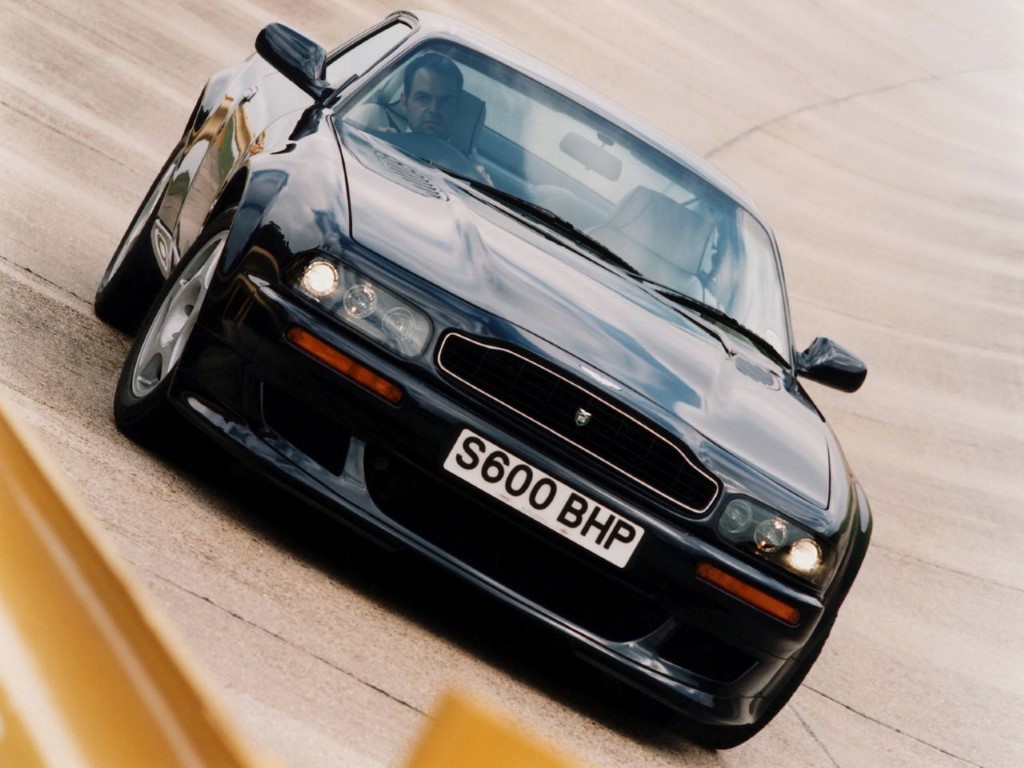
  • Six headlights (three on each side), covered by glass lenses.
  • A solid front grille with only two small openings for air intake, creating an unmistakable "face".
  • 362mm front brake discs with AP Racing 4-piston calipers.

The Final Evolutions: V600 and Le Mans

  • V600 (1998): For customers who thought 550 hp was not enough, the factory offered the V600 package, raising power to 600 bhp and 600 lb-ft of torque. This was achieved through modifications to the superchargers and the exhaust system.
  • Vantage Le Mans (1999-2000): The final farewell to the platform. Limited to 40 units to celebrate the 40th anniversary of the victory at Le Mans (1959). The design included a front grille with "nostrils" for better cooling and an interior with a centralized rev counter and titanium trim. Available in V550 or V600 engine specifications. It is considered by many the pinnacle of the Newport Pagnell era.

The Twilight: V8 Coupé and V8 Volante (1996–2000)

In 1996, the "Virage" name was officially retired for the base model, being replaced by the V8 Coupé.

  • Rationalization: The V8 Coupé was essentially an updated Virage with the Vantage aesthetic (mesh grille and round headlights, but without the super-wide bodywork). The naturally aspirated engine was retained, now tuned for 350 bhp and better low-end torque.
  • V8 Volante Long Wheelbase (LWB): Launched in 1997, this model resolved the main criticism of the original Virage Volante: rear space. The chassis was lengthened by 200mm (8 inches), creating a true 4-seater convertible. Only 63 units were made, making it extremely collectible.
Production and Specifications Table (Generation 1: 1989–2000)
Model Period Units (Estimated) Engine Power
Virage Coupé 1989–1996 ~411 5.3L V8 Naturally Aspirated 330 bhp
Virage Volante 1992–1996 ~233 5.3L V8 Naturally Aspirated 330 bhp
Vantage (V550) 1993–2000 ~239 5.3L V8 Twin-Supercharged 550 bhp
Vantage Le Mans 1999–2000 40 5.3L V8 Twin-Supercharged 550/600 bhp
V8 Coupé 1996–2000 101 5.3L V8 Naturally Aspirated 350 bhp
V8 Volante (LWB) 1997–2000 63 5.3L V8 Naturally Aspirated 354 bhp
Shooting Brake 1992–1994 6–8 5.3L / 6.3L V8 Variable
Lagonda (Saloon/SB) 1993–1996 ~9–12 5.3L / 6.3L V8 Variable
Estimated Total 1989–2000 ~1,050 to 1,100
The Second Generation (2011–2012)

Rebirth in the Gaydon Era

More than a decade after the last Virage left Newport Pagnell, Aston Martin, now based in Gaydon and operating independently (after being sold by Ford), decided to revive the name. The context, however, could not have been more different. The brand had a consolidated product line based on the VH (Vertical-Horizontal) aluminum architecture.

The launch of the new Virage at the 2011 Geneva Motor Show was strategic. Aston Martin identified a narrow gap in its V12 lineup:

  • DB9: The classic GT, focused on comfort and elegance.
  • DBS: The aggressive supercar, focused on performance and the use of carbon fiber.

The 2011 Virage was positioned exactly in the middle. The idea was to offer a car that had the elegance of the DB9 but with an extra dose of sportiness and visual exclusivity, without reaching the brutality (and the price tag) of the DBS.

Design and Visual Differentiation

At first glance, the 2011 Virage looked very much like the DB9, which drew criticism. However, a detailed analysis reveals that almost all the body panels were new or exclusive.

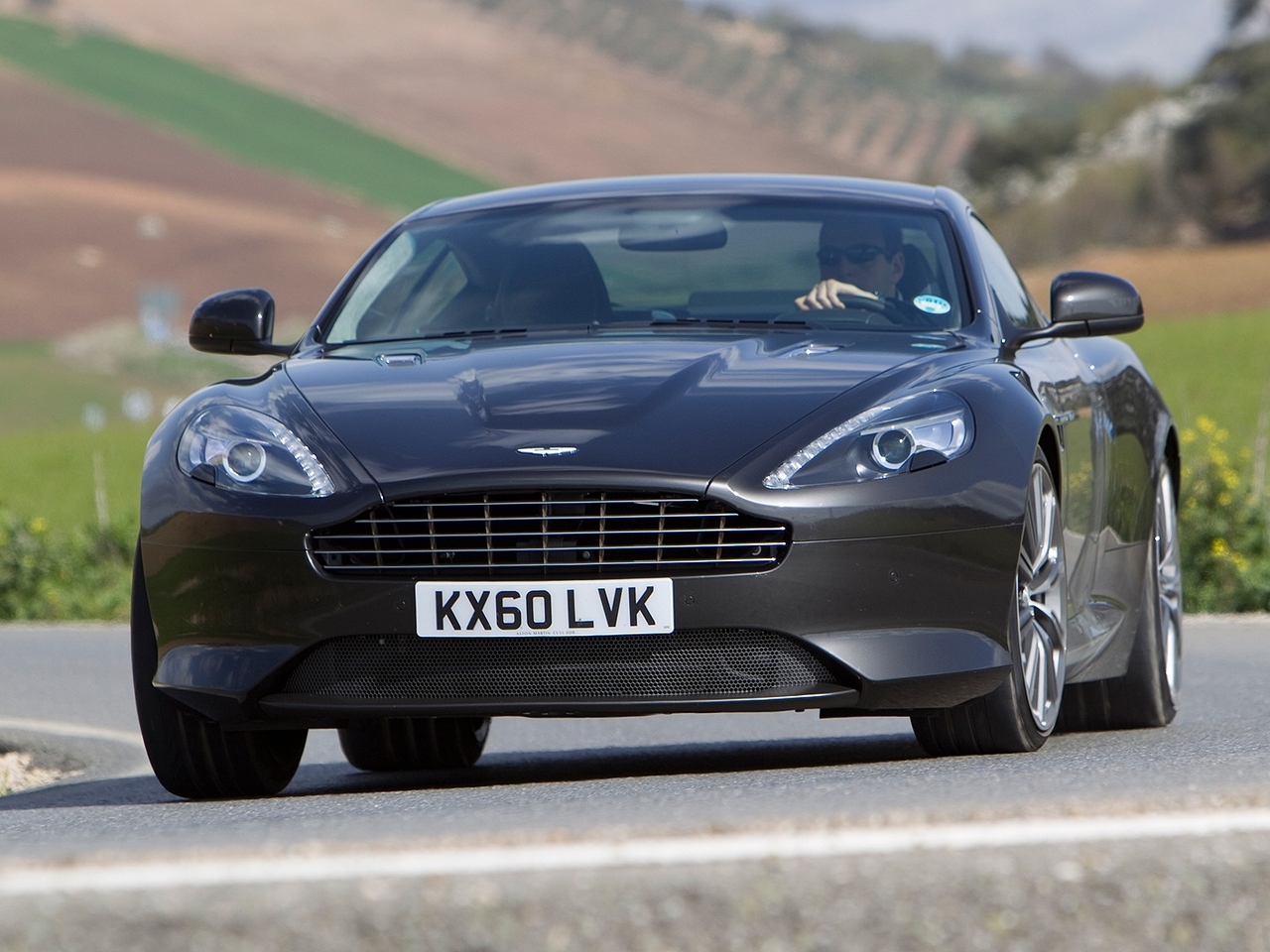
  • Front: The front grille was a metal piece with five chamfered horizontal blades, directly inspired by the One-77 hypercar. The front bumper was simpler and cleaner than the DBS's, eliminating the visible parking sensors.
  • Headlights: The Virage debuted a new bi-xenon headlight design with an integrated LED strip for daytime running lights, giving it a more modern look than the DB9 of the time.
  • Side and Rear: The side skirts were pronounced, evoking the DBS, and the rear diffuser was painted in the body color, emphasizing the width of the car.

Engineering and Performance (VH Generation II)

The Virage used the evolution of Aston Martin's bonded aluminum platform.

AM11 V12 Engine

The engine was the venerable naturally aspirated 6.0-liter (5,935 cc) V12, hand-assembled in Cologne, Germany.

  • Power: 490 bhp (497 PS / 366 kW) at 6,500 rpm.
  • Torque: 570 Nm (420 lb-ft) at 5,750 rpm. This placed the Virage exactly between the DB9's 477 hp and the DBS's 517 hp. The power delivery was calibrated to be more urgent than in the DB9, yet still civilized.

Touchtronic II Transmission

Unlike the first generation, there was no manual option. The Virage came exclusively with the ZF 6-speed "Touchtronic II" automatic transmission. Rear-mounted (transaxle) to ensure a perfect 50:50 weight distribution, the gearbox was recalibrated to offer faster shifts in Sport mode, while maintaining smoothness in urban use.

Driving Dynamics: The ADS System

The great asset of the Virage was its chassis. It came standard with the new generation Adaptive Damping System (ADS). The system "read" the road and the driver's behavior, adjusting the stiffness of the dampers in real time.

  • Normal Mode: Focused on comfort, absorbing imperfections better than the DBS.
  • Sport Mode: Stiffened the suspension for body control in fast corners. In addition, the Virage came standard with Carbon-Ceramic Matrix (CCM) brakes, which were optional or unavailable on the DB9. This reduced unsprung weight and guaranteed track-level braking performance without fade.

Second Generation Variants

  • Virage Coupé: Available in 2+2 (small rear seats) or 2+0 (cargo shelf) configurations. 0 to 100 km/h performance in 4.6 seconds and a top speed of 299 km/h.
  • Virage Volante: Launched simultaneously, it shared the coupé's mechanics. It received structural reinforcements that increased the weight to around 1,860 kg, guaranteeing exceptional torsional rigidity.
  • Zagato Centennial Shooting Brake (2014): A one-off model created by Zagato for Aston Martin's 100th anniversary. Completely different from the production car, with angular and controversial lines.

The Premature End and Rarity (2012)

The second generation Virage was discontinued in September 2012, after only 18 months of production.

The Reason for the End: The model fell victim to its own positioning strategy. The price difference between the DB9 and the Virage was difficult to justify for many customers, given that the aesthetics were very similar. Furthermore, Aston Martin was preparing a major update for the DB9 in 2013. The "New DB9" ended up inheriting the headlight design, the updated chassis, and the more powerful engine (now with 517 hp) that were exclusive to the Virage. In practice, the Virage became the "draft" or production prototype for the final evolution of the DB9.

Production Numbers: Due to its short life, the modern Virage is one of the rarest series production Aston Martins of the modern era.

  • Grand Total: Approximately 1,044 units.
  • Coupés: Estimated at 656 units.
  • Volantes: Estimated at 388 units. This scarcity, combined with the fact that it is mechanically superior to pre-2013 DB9s, makes the Virage a hidden "gem" in the used car market.
Conclusion: Legacy Analysis

When comparing the two generations of the Virage, a clear pattern of transition and adaptation emerges.

The 1989 Virage was a war hero. It kept Aston Martin alive during dark times, carrying the weight of the Newport Pagnell tradition on its aluminum shoulders. It represents pure mechanical engineering, brute force, and the exclusivity of hand-built construction. Its variants, especially the Vantage V600, remain as icons of an era where excessive power and the lack of electronic aids were celebrated.

The 2011 Virage, on the other hand, is a case study in refinement and product strategy. It proved that the VH platform still had potential for evolution, introducing technologies (such as standard carbon-ceramic brakes) that would raise the brand's standard. Although commercially redundant at the time, today it offers enthusiasts the opportunity to own a rare V12 Aston Martin, with the best design of the era and balanced driving dynamics, without the price premium associated with the DBS badge.

Both cars, separated by decades and philosophies, fulfill the promise of their name: they represented decisive curves on Aston Martin's long and winding road.

Generational Comparison Table
Characteristic Virage Generation 1 (1989-2000) Virage Generation 2 (2011-2012)
Manufacturing Location Newport Pagnell (Manual) Gaydon (Assembly Line)
Body Material Hand-formed aluminum Aluminum, Magnesium, Composites
Engine 5.3L V8 (330-600 hp) 6.0L V12 (490 hp)
Transmission 5/6-speed Manual or 3/4-speed Auto 6-speed Touchtronic II Automatic
Philosophy Aristocratic Muscle Car Technological Grand Tourer
Main Legacy Base for the Vantage V600 Base for the DB9 Gen 4
Total Units ~1,050 ~1,044

Technical data based on: • Official manufacturer catalogs • EPA / WLTP documentation when available • Official press releases

Editorial content produced by Gabriel Carvalho. | Última revisão: Dezembro/2025.