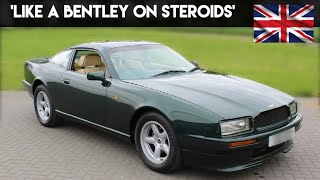
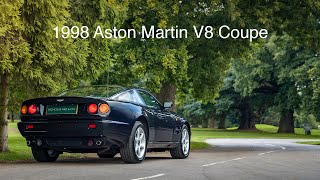
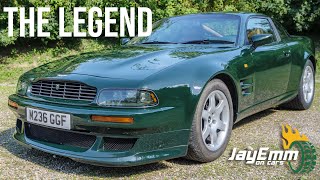
1st Generation
(1988 - 1999)
5.3 Twin Supercharged
608 cv

Technical specifications, versions, and history for the Aston Martin Virage.
Select a generation to see available versions
(1988 - 1999)

(2011 - 2012)
Select a powertrain to view full technical specifications
Aston Martin's history is often characterized by cycles of financial turbulence followed by periods of stability and technical innovation. Within this corporate narrative, the name "Virage" holds a unique position, serving as the protagonist in two completely distinct chapters of the British manufacturer's saga. The term, derived from the French language meaning "curve" or "change of direction", proved prophetic in both of its incarnations, albeit for divergent reasons.
The first generation of the Virage, launched in the late 1980s, represented the last stand of the "old guard" of Newport Pagnell. It was a vehicle conceived in a transitional era, where handcrafted manufacturing collided with modern homologation requirements and the need for efficiency brought by the brand's acquisition by the Ford Motor Company. This model was not just a replacement for the venerable V8 line that sustained the company for two decades; it was the vehicle that carried Aston Martin through the economic recession of the early 90s, allowing the brand to survive long enough to see its subsequent rebirth with the DB7.
The second generation, introduced in 2011, emerged in a radically different context. Produced at the modern Gaydon factory, this iteration of the Virage was an exercise in niche precision within the company's VH (Vertical-Horizontal) architecture. Designed to fill an almost imperceptible gap between the DB9 Grand Tourer and the aggressive DBS sports car, the 2011 Virage illustrates the challenges of product positioning in the contemporary luxury market. Its ephemeral existence of only 18 months instantly transformed it into a collector's curiosity, a model that, ironically, is rarer than many of its limited predecessors.
This report is dedicated to an exhaustive analysis of both generations, exploring not only the technical specifications and production numbers but also the socioeconomic context, engineering decisions, and design nuances that define the identity of the Aston Martin Virage.
To understand the original Virage, it is necessary to revisit Aston Martin's climate in the mid-1980s. Under the charismatic leadership of Victor Gauntlett, the company had regained some stability, but its product line — based on the V8 introduced in 1969 — was hopelessly aging. Emissions regulations, especially in the United States, were strangling the performance of the old carbureted engines, and the "muscular" design of the 70s was going out of style in favor of a more aerodynamic and smooth aesthetic.
The need for a new model was existential. The project, designated internally as DP2034, had a clear mandate: to create a car that was modern enough to take Aston Martin into the 21st century, but that maintained the traditional construction of a separate chassis and hand-formed aluminum bodywork, preserving the brand's artisanal identity.
The design choice was not trivial. Aston Martin invited five design studios to submit proposals. Unlike the tradition of using Italian coachbuilders like Zagato or Touring, the winning proposal came from a British duo: John Heffernan and Ken Greenley. They were automotive design professors at the Royal College of Art in London.
Heffernan and Greenley's proposal won because it managed to balance modernity with heritage. The design featured clean, flush surfacing, eliminating the rain gutters and prominent chrome bumpers of previous models. However, it maintained the imposing physical "presence" that the brand's customers demanded. The car looked like it had been sculpted from a single block of solid aluminum, a characteristic that would become the model's visual signature.
The official presentation took place at the Birmingham Motor Show in 1988. The reception was enthusiastic, with the press praising the modernization of the classic lines. However, the commercial launch coincided with the collapse of the supercar market and the global recession of the early 90s, which meant that the Virage, destined to be a sales success, became an extremely low-volume product, dependent on ultra-rich and loyal customers.
The Virage was the first truly new Aston Martin in almost 20 years. Although it maintained the front-engine, rear-wheel-drive philosophy, the technical execution was significantly updated compared to its predecessor.
The heart of the Virage was a profound evolution of the lightweight alloy V8 engine designed by Polish engineer Tadek Marek. However, to meet the new power and emissions requirements, Aston Martin needed outside help.
The transfer of this power to the rear wheels was managed by two main transmission options, reflecting the car's dual personality as a sports car and grand tourer:
The Virage chassis was a steel platform, onto which the aluminum bodywork was attached. The suspension represented a mix of tradition and modernity:
To make the production of such a low-volume car viable, Aston Martin resorted to "cannibalizing" parts from major manufacturers, a common practice in the British niche industry.
The Virage chassis proved to be extremely adaptable. During the 90s, Aston Martin used this base to create a complete family of vehicles, trying to fulfill every desire of its exclusive clientele.
Aston Martin tradition dictates that every coupé must have a convertible counterpart ("Volante"). The Virage Volante debuted at the 1990 Birmingham Motor Show.
Shortly after the launch, some customers criticized that the Virage, with 330 hp and weighing almost 1,800 kg, was not fast enough to compete with the supercars of the time. Aston Martin's response did not come from the main production line, but rather from the "Works Service" division.
The flexibility of manual construction allowed the creation of extremely rare models, often custom-made for royalty.
In 1993, Aston Martin decided that the Virage platform needed a dedicated high-performance version, not just aftermarket conversions. The result was the return of the Vantage name. It is crucial to note that, although based on the Virage chassis, this car was marketed simply as the "Aston Martin Vantage", dropping the Virage name to distance itself from the less powerful base model.
The Vantage was a technical tour de force. The goal was to create the most powerful and fastest car in the world capable of carrying four people.
Visually, the Vantage was intimidating. It adopted the wide bodywork, but with clear distinctions:
In 1996, the "Virage" name was officially retired for the base model, being replaced by the V8 Coupé.
| Model | Period | Units (Estimated) | Engine | Power |
|---|---|---|---|---|
| Virage Coupé | 1989–1996 | ~411 | 5.3L V8 Naturally Aspirated | 330 bhp |
| Virage Volante | 1992–1996 | ~233 | 5.3L V8 Naturally Aspirated | 330 bhp |
| Vantage (V550) | 1993–2000 | ~239 | 5.3L V8 Twin-Supercharged | 550 bhp |
| Vantage Le Mans | 1999–2000 | 40 | 5.3L V8 Twin-Supercharged | 550/600 bhp |
| V8 Coupé | 1996–2000 | 101 | 5.3L V8 Naturally Aspirated | 350 bhp |
| V8 Volante (LWB) | 1997–2000 | 63 | 5.3L V8 Naturally Aspirated | 354 bhp |
| Shooting Brake | 1992–1994 | 6–8 | 5.3L / 6.3L V8 | Variable |
| Lagonda (Saloon/SB) | 1993–1996 | ~9–12 | 5.3L / 6.3L V8 | Variable |
| Estimated Total | 1989–2000 | ~1,050 to 1,100 |
More than a decade after the last Virage left Newport Pagnell, Aston Martin, now based in Gaydon and operating independently (after being sold by Ford), decided to revive the name. The context, however, could not have been more different. The brand had a consolidated product line based on the VH (Vertical-Horizontal) aluminum architecture.
The launch of the new Virage at the 2011 Geneva Motor Show was strategic. Aston Martin identified a narrow gap in its V12 lineup:
The 2011 Virage was positioned exactly in the middle. The idea was to offer a car that had the elegance of the DB9 but with an extra dose of sportiness and visual exclusivity, without reaching the brutality (and the price tag) of the DBS.
At first glance, the 2011 Virage looked very much like the DB9, which drew criticism. However, a detailed analysis reveals that almost all the body panels were new or exclusive.
The Virage used the evolution of Aston Martin's bonded aluminum platform.
The engine was the venerable naturally aspirated 6.0-liter (5,935 cc) V12, hand-assembled in Cologne, Germany.
Unlike the first generation, there was no manual option. The Virage came exclusively with the ZF 6-speed "Touchtronic II" automatic transmission. Rear-mounted (transaxle) to ensure a perfect 50:50 weight distribution, the gearbox was recalibrated to offer faster shifts in Sport mode, while maintaining smoothness in urban use.
The great asset of the Virage was its chassis. It came standard with the new generation Adaptive Damping System (ADS). The system "read" the road and the driver's behavior, adjusting the stiffness of the dampers in real time.
The second generation Virage was discontinued in September 2012, after only 18 months of production.
The Reason for the End: The model fell victim to its own positioning strategy. The price difference between the DB9 and the Virage was difficult to justify for many customers, given that the aesthetics were very similar. Furthermore, Aston Martin was preparing a major update for the DB9 in 2013. The "New DB9" ended up inheriting the headlight design, the updated chassis, and the more powerful engine (now with 517 hp) that were exclusive to the Virage. In practice, the Virage became the "draft" or production prototype for the final evolution of the DB9.
Production Numbers: Due to its short life, the modern Virage is one of the rarest series production Aston Martins of the modern era.
When comparing the two generations of the Virage, a clear pattern of transition and adaptation emerges.
The 1989 Virage was a war hero. It kept Aston Martin alive during dark times, carrying the weight of the Newport Pagnell tradition on its aluminum shoulders. It represents pure mechanical engineering, brute force, and the exclusivity of hand-built construction. Its variants, especially the Vantage V600, remain as icons of an era where excessive power and the lack of electronic aids were celebrated.
The 2011 Virage, on the other hand, is a case study in refinement and product strategy. It proved that the VH platform still had potential for evolution, introducing technologies (such as standard carbon-ceramic brakes) that would raise the brand's standard. Although commercially redundant at the time, today it offers enthusiasts the opportunity to own a rare V12 Aston Martin, with the best design of the era and balanced driving dynamics, without the price premium associated with the DBS badge.
Both cars, separated by decades and philosophies, fulfill the promise of their name: they represented decisive curves on Aston Martin's long and winding road.
| Characteristic | Virage Generation 1 (1989-2000) | Virage Generation 2 (2011-2012) |
|---|---|---|
| Manufacturing Location | Newport Pagnell (Manual) | Gaydon (Assembly Line) |
| Body Material | Hand-formed aluminum | Aluminum, Magnesium, Composites |
| Engine | 5.3L V8 (330-600 hp) | 6.0L V12 (490 hp) |
| Transmission | 5/6-speed Manual or 3/4-speed Auto | 6-speed Touchtronic II Automatic |
| Philosophy | Aristocratic Muscle Car | Technological Grand Tourer |
| Main Legacy | Base for the Vantage V600 | Base for the DB9 Gen 4 |
| Total Units | ~1,050 | ~1,044 |
Images of the Aston Martin Virage