The first generation of the Audi S7 was built on the MLB platform (Modularer
Längsbaukasten), a longitudinal modular matrix from the Volkswagen Group that allowed Audi
to position the engine further back relative to the front axle, improving weight
distribution compared to previous models. The model was revealed in 2011 and hit the
global market as a 2012/2013 model, immediately setting a new design
standard.
Design and Visual Identity
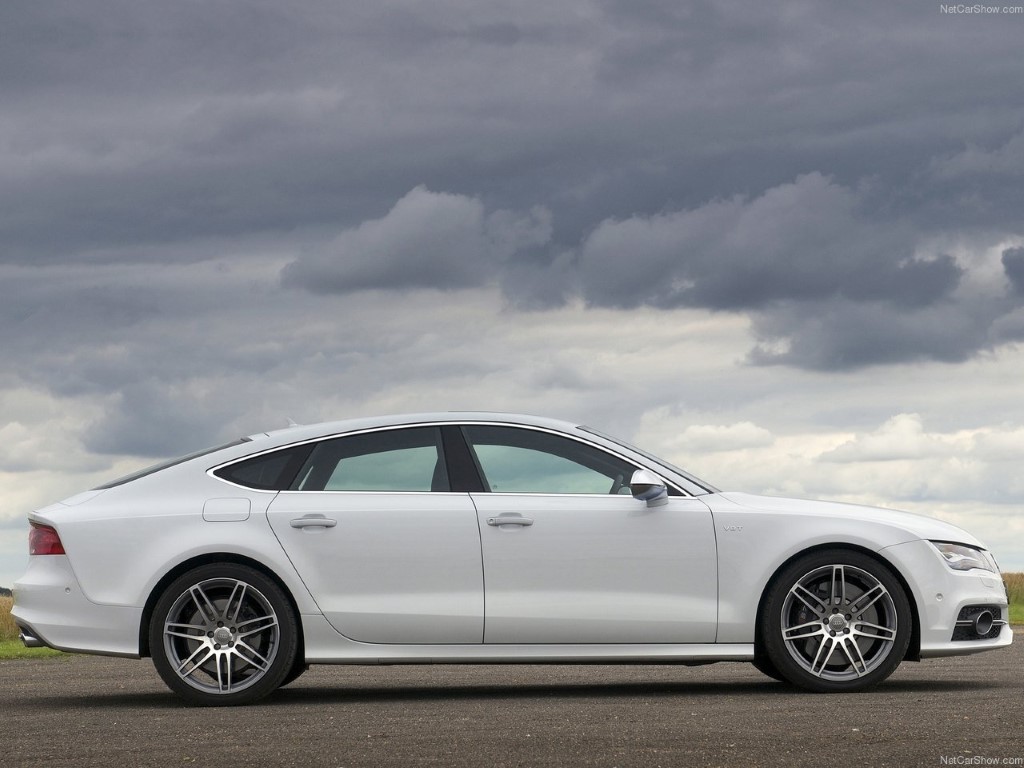
The design of the S7 C7 is frequently cited by critics and enthusiasts as one of the high
points of automotive aesthetics in the 2010s. Differentiating itself from the conventional A7,
the
S7 adopted the "discreet sportiness" philosophy of the S line.
- Front: The "Singleframe" front grille received a platinum gray finish
with double horizontal chrome slats, an exclusive signature of the
S models. The front bumper was redesigned with more prominent side air intakes
to feed the intercoolers and cool the braking system.
- Profile: The silhouette is defined by the "Tornado Line", a sharp
crease that runs along the entire side of the car, from the headlight to the taillight.
The
brushed aluminum mirror caps ("Alu-Optic") served as an
immediate visual identifier of the sports version.
- Rear: The S7's trademark manifested itself in the four oval exhaust
outlets, grouped in pairs at the ends of the rear diffuser. A retractable
spoiler, integrated into the trunk lid, automatically raised at
130 km/h to increase aerodynamic pressure (downforce) on the rear axle, or could
be deployed manually.
Mechanical Engineering: The 4.0 TFSI V8 Heart
The core element of the S7 C7 experience was the 4.0 TFSI biturbo V8 engine (Engine
Code: CEUC). This powerplant represented a significant technological leap for Audi,
replacing the old naturally aspirated V10s from the previous S6/S8 with a smaller,
supercharged, and more efficient unit.
Specifications and Technical Data (S7 C7)
- Configuration: 90-degree V8, Biturbo
- Displacement: 3,993 cm³
- Maximum Power: 420 hp (309 kW) @ 5,500–6,400 rpm
- Maximum Torque: 56.1 kgfm (550 Nm) @ 1,400–5,200 rpm
- 0–100 km/h Acceleration: 4.7 seconds
- Top Speed: 250 km/h (Electronically Limited)
"Hot-V" Architecture: A crucial innovation of this engine was the
positioning of the two twin-scroll turbochargers inside the "V"
formed by the cylinder banks, rather than on the outer sides. This configuration
drastically shortened the path the exhaust gases needed to travel to the
turbines, resulting in almost instantaneous acceleration response and the elimination of
"turbo lag".
Cylinder on Demand (COD): To reconcile the performance of a V8 with
fuel consumption requirements, Audi implemented the Cylinder on Demand system. In situations of
light or medium load (such as highway cruising speed), the system deactivates
cylinders 2, 3, 5, and 8, closing the valves and cutting off the injection. The engine then
operates
as a 2.0-liter V4. The transition occurs in milliseconds and is virtually
imperceptible to the driver. To counteract the natural vibrations of a V4 engine,
Audi installed active engine mounts (which generate counter-vibrations) and the Active
Noise Cancellation system through the car's speakers.
Transmission and Drivetrain: S-Tronic Precision
Unlike the RS7, which used a conventional 8-speed automatic gearbox (ZF
8HP) to handle torque exceeding 700 Nm, the S7 C7 was equipped with the 7-speed
S-Tronic transmission (Code DL501). It is a wet dual-clutch gearbox,
known for its surgical speed in gear shifts and the feeling of a
direct connection between the accelerator and the wheels.
The permanent Quattro all-wheel drive is the dynamic pillar of the model. In this generation, the system
used a Crown Gear center differential, lighter and more compact than the
traditional Torsen. Under normal conditions, the torque distribution was 40% to the
front axle and 60% to the rear, giving a dynamic behavior closer
to a rear-wheel-drive car. Optionally, the Rear Sport Differential
actively distributed force between the rear wheels, accelerating the outer wheel in
corners to mitigate understeer (the car's tendency to push wide).
Launch and Context in Brazil
The Audi S7 Sportback was introduced to the Brazilian market in the second half of 2013. The
economic context of the time still allowed the importation of niche vehicles with some
viability, although the "Super IPI" (higher industrial tax) was already in effect.
- Price and Positioning: The model arrived with a suggested price of around
R$ 480,000 to R$ 500,000. It competed directly with the Mercedes-Benz CLS 500 and the
BMW 650i Gran Coupe.
- Brazil Package: Audi do Brasil chose to bring the S7 in
extremely comprehensive configurations ("Full Options"). Items that were optional in
Europe, such as the Head-Up Display, the Night Vision system (thermal camera for
detecting pedestrians and animals), and the advanced sound system (often Bose or
Bang & Olufsen), usually came standard on Brazilian units.
- Volume: Sales expectations were an absolute niche, projecting
about 20 to 30 units per year, which guarantees the model's rarity today in the
used car market.