1st Generation
(2011 - 2015)
Technical specifications, versions, and history for the Citroen DS5.
Select a generation to see available versions
(2011 - 2015)
Select a powertrain to view full technical specifications
The Citroën DS5 represents one of the most audacious and aesthetically provocative chapters in the French automotive industry in the 21st century. Launched as the pinnacle of the DS (Different Spirit) line within Citroën's structure, the model was not just a luxury vehicle, but a declaration of the brand's stylistic and technical independence from the conservative standards of the European premium segment. Between 2011 and 2015, a period in which it officially sported the Citroën "Double Chevron" logo and the original brand name, the DS5 defied conventional body classifications, fusing elements of hatchbacks, station wagons, and coupes into a silhouette that the manufacturer itself described as a "shooting brake possessed by the spirit of a Gran Turismo."
This report details the complete trajectory of the model during its phase under the Citroën insignia, exploring everything from the conceptual origins dating back to the early 2000s to the transition to the autonomous DS brand in 2015. Technical specifications, engineering innovations, global production data, and the market nuances that defined this model as an icon of "Créative Technologie" will be covered.
The story of the Citroën DS5 does not begin at its official launch, but rather six years earlier, on one of the most important stages in the global automotive sector. In September 2005, during the Frankfurt Motor Show, Citroën revealed the C-SportLounge concept. Under the design direction of Jean-Pierre Ploué and with exterior lines drawn by designer Frédéric Soubirou, the C-SportLounge was tasked with reinventing the MPV (multi-purpose vehicle) sedan. The goal was to create a single-volume vehicle that offered the attributes of a sports car with the status of a high-luxury premium model.
Frédéric Soubirou, when describing the creative process, highlighted that the car's shape started as something sculpted, polished, and smoothed, like a pebble shaped by water. The resulting silhouette was monolithic, a characteristic that was preserved almost entirely in the transition to the final production model. One of the most striking elements born in this concept was the chrome "saber", a metallic piece extending from the tip of the headlights to the base of the windshield. This detail was not merely aesthetic; it served to give the car the visual reading of a strong and defined hood, despite the steep and forward-leaning inclination of the windshield common in MPVs.
Citroën sought validation in the C-SportLounge to enter a segment where aerodynamic efficiency and visual impact had to go hand in hand. The concept featured a drag coefficient (Cd ) of just 0.26, an impressive value that demonstrated the brand's concern with energy efficiency and high-speed performance. When the DS5 finally hit the streets in 2011, it retained much of this heritage, presenting itself as an aerodynamic sculpture composed of lines that sometimes flowed smoothly and other times appeared tense and muscular.
The Citroën DS5 was revealed to the world in its definitive production form at the Shanghai Auto Show in April 2011. The choice of China for the world premiere was no accident. The Chinese market had already been the world's largest since 2009, and PSA Peugeot Citroën saw the DS line as the perfect tool to capture the growing demand for premium vehicles in that territory. The model was positioned to fill the gap left by the first-generation Citroën C5 hatchback, since the second-generation C5 was now offered only as a traditional sedan and station wagon.
The launch in Europe took place shortly after, in November 2011, consolidating the DS5 as the third member of the DS family, following the success of the DS3 and DS4. The initial reception was marked by surprise at its unique proportions. At 4,530 mm long and 1,871 mm wide, the DS5 had dimensions close to those of a Lancia Delta, but with a much more imposing road presence.
Citroën did not intend for the DS5 to compete directly with the driving dynamics of models like the BMW 3 Series. Instead, the strategy was to offer a distinct and luxurious alternative, focused on design and internal refinement. To reinforce this connection with the brand's heritage of innovation, Citroën even held photoshoots of the DS5 alongside the legendary Concorde aircraft, emphasizing the aerospace inspiration that permeated the entire project.
An important milestone in the model's history occurred in May 2012, when a convertible Citroën DS5 Hybrid4 was chosen by the newly elected President of France, François Hollande, for his inauguration parade. This event provided the model with unprecedented global exposure, linking the DS5 to values of modernity, environmental technology (due to the hybrid powertrain), and French national prestige.
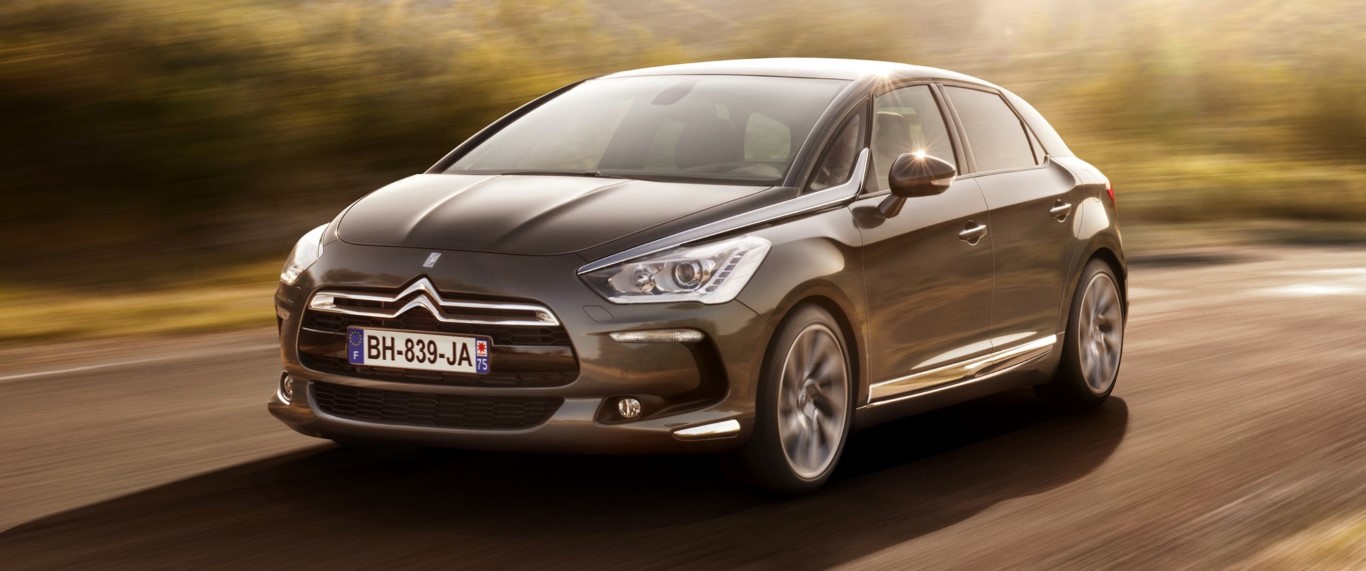
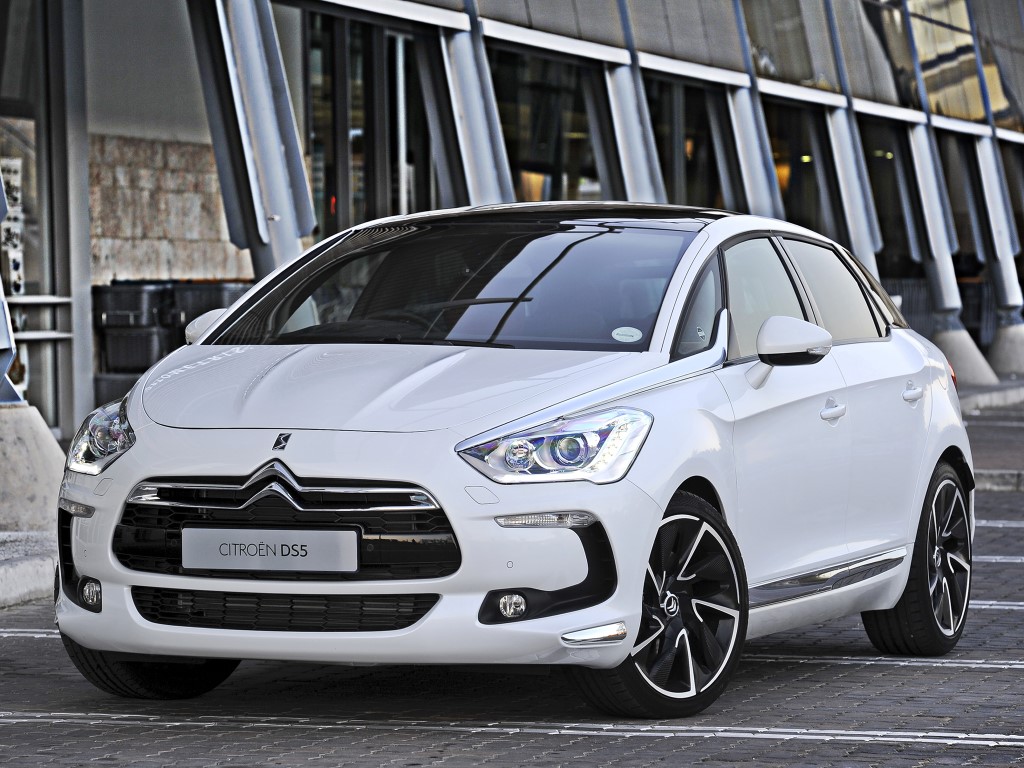
The exterior design of the Citroën DS5 is one of its most polarizing and, at the same time, celebrated characteristics. The front is dominated by a large air intake and a generous chrome grille housing the Citroën double chevron, topped by the DS line emblem. The headlights, with an incisive design, are underlined by an LED light signature that gives the car a technological and striking "look."
The side profile is where the DS5 best expresses its uniqueness. The aforementioned chrome "saber" catches the light and creates an interplay of shadows with the curves of the rear wings, a distinctive feature of the DS line vehicles. The roof has a subtle curvature flowing into a sporty rear spoiler, while the muscular wheel arches envelop alloy wheels with complex designs and diamond-cut finishes.
At the rear, the design reinforces the car's wide and stable stance. The taillights feature a signature with six light guides, and the bumper integrates two oversized chrome exhaust outlets, which contribute to the Gran Turismo look. Aerodynamic efficiency was kept as a high priority, resulting in a Cd of 0.29 for the production model. Aerodynamic deflectors were integrated even into the polycarbonate rear side windows, showing the level of technical detailing applied.
| Exterior Dimension | Measurement (mm) |
|---|---|
| Length | 4,530 |
| Width (without mirrors) | 1,871 |
| Height | 1,504 - 1,539 |
| Wheelbase | 2,727 |
| Front Track | 1,575 |
| Rear Track | 1,603 |
If the DS5's exterior was futuristic, the interior was designed to transport occupants into the cockpit of a modern jet. The driving position was described as driver-focused, blending the seating of a coupe with the layout of a Gran Turismo. The steering wheel is nearly vertical, with a broad center, and the center console is elevated, positioning the gear lever naturally for the driver.
The most symbolic element of the cabin is the "cockpit" roof. It features three independent light inlets and two center consoles: a low one between the seats, and another mounted on the roof, right above the driver's head, just like in an aircraft. These consoles house toggle switches, rotary selectors, and controls for the audio and navigation systems, all designed to be operated intuitively.
Internal refinement was elevated through the use of authentic materials. Citroën used real aluminum in details like the door handles and around the air vents. The seats could be upholstered in "Club" leather, featuring the exclusive "watchstrap" design, a trademark of the DS line that required a complex manual sewing process. An analog clock, standard on higher trims (DStyle and DSport), added a touch of classic elegance to the technological dashboard.
In terms of practicality, despite the focus on style, the DS5 offered five real seats and a trunk with a capacity of up to 468 liters (VDA) in conventional versions, a volume comparable to that of a sports wagon (Sportwagon). There were also smart storage compartments, such as a 13-liter space under the center armrest, which was illuminated and cooled.
One of the most notable technical curiosities of the Citroën DS5 is its platform. Unlike the contemporary Citroën C5, which used Platform 3 and the famous Hydractive hydropneumatic suspension, the DS5 was built on the PF2 (or BVH2) platform. This was a stretched version of the base used in the Citroën C4 and the Peugeot 3008.
The decision to use the PF2 platform was motivated by production efficiency and packaging issues. The DS5 became the first Citroën brand car to be assembled at Peugeot's flagship plant in Sochaux, France, sharing assembly lines with models from the sister brand. Using this architecture allowed the car to be 25 cm shorter than a C5 sedan, resulting in greater urban agility and lower total weight.
However, this choice brought compromises in the suspension. While the C5 was known for its "magic carpet" ride, the combustion versions of the DS5 used a torsion beam rear suspension, which was criticized in its early years for offering an excessively firm and sometimes uncomfortable ride on uneven surfaces. Only the Hybrid4 version, out of necessity to accommodate the rear electric motor, used an independent multi-link suspension, providing superior ride comfort.
During its phase as a Citroën, the DS5 offered a varied range of engines, from units focused on fuel economy to high-performance variants developed in partnership with BMW.
The gasoline options centered around the 1.6 THP (Turbo High Pressure) engine. The THP 155 version delivered 156 hp and was generally mated to a six-speed automatic transmission supplied by Aisin, focusing on smoothness of operation. At the top of the gasoline range was the THP 200, an engine that also equipped the DS3 Racing. With 200 hp and 275 Nm of torque, this version was offered with a six-speed manual gearbox, allowing for 0 to 100 km/h acceleration in 8.5 seconds and a top speed of 235 km/h.
The diesel offering was robust and popular in Europe. It started with the 110 hp or 115 hp 1.6 e-HDi (Airdream) engine, equipped with a six-speed automated manual transmission (EGS6 or ETG6). The intermediate engine was the 160 hp or 163 hp 2.0 HDi, available with either a manual or automatic transmission.
Starting in 2014, Citroën introduced BlueHDi technology, which used AdBlue injection to reduce nitrogen oxide emissions (NOx ) and meet Euro 6 standards. The 2.0 BlueHDi engine was offered in 150 hp and 180 hp versions, the latter delivering 400 Nm of torque and becoming the new benchmark in terms of diesel performance in the lineup.
| Engine Specification | Power (hp) | Torque (Nm) | Transmission Type |
|---|---|---|---|
| 1.6 THP 155 | 156 | 240 | 6-speed Automatic |
| 1.6 THP 200 | 200 | 275 | 6-speed Manual |
| 1.6 e-HDi 110/115 | 112 / 114 | 270 | 6-speed Automated |
| 1.6 BlueHDi 120 | 120 | 300 | Manual or Automatic |
| 2.0 HDi 160 | 163 | 340 | Manual or Automatic |
| 2.0 BlueHDi 150 | 150 | 370 | 6-speed Manual |
| 2.0 BlueHDi 180 | 181 | 400 | 6-speed Automatic |
One of Citroën's greatest technological achievements with the DS5 was the introduction of the Hybrid4 system. This was the world's first production car to combine a diesel engine with an electric motor to form a hybrid system. The powertrain consisted of a 163 hp 2.0 HDi engine driving the front wheels and a 37 hp (27 kW) electric motor mounted on the rear axle. Together, they provided a combined output of 200 hp and four-wheel drive under certain conditions.
The Hybrid4 system offered four driving modes selectable by a rotary dial on the console:
In terms of efficiency, the DS5 Hybrid4 was capable of emitting only 99g/km or 107g/km of CO2 , depending on the chosen wheels, and achieved an impressive average consumption for a vehicle of its size and weight (1,810 kg). However, the system's complexity resulted in a trunk reduced to 325 liters due to the space occupied by the batteries and the rear electric motor.
The dynamic trajectory of the Citroën DS5 was marked by significant evolution. At launch, the car was widely criticized by the specialized press due to the excessive stiffness of its PF2 platform-based suspension. The sporty tuning, combined with 18 or 19-inch wheels, resulted in a driving experience that many considered un-"Citroën"-like, lacking the refinement expected of a luxury car.
Aware of these criticisms, Citroën carried out a quiet technical update in late 2013, even before the major 2015 facelift. The brand's engineering revised the shock absorbers and suspension bushings. New shock absorbers with PLV (Pre-loaded Linear Valve) technology, developed by SACHS, were introduced, which allowed for a smoother transition of damping force and a longer compression stroke. The result was a significantly more comfortable car, capable of dealing with potholes and uneven asphalt much more competently, without sacrificing the body control that was one of its initial virtues.
As part of the premium positioning strategy, Citroën launched several limited editions of the DS5, each focused on highlighting a different aspect of the brand's design or heritage.
The manufacturing of the Citroën DS5 was an international endeavor involving massive investments in Europe and Asia.
European production was centered in Sochaux. This facility was historic because, for the first time in decades, a Citroën brand vehicle was produced in a plant led by Peugeot. In 2011, the first year of partial production, 4,560 units were assembled. In 2012, the first full year, production jumped to 29,700 units in Sochaux.
The expansion into China was carried out through the CAPSA (Changan PSA) joint venture. In September 2013, Citroën inaugurated the new factory in Shenzhen, initially dedicated to the local production of the DS5. This factory had an annual production capacity of up to 200,000 vehicles and allowed the DS5 to be sold in China at competitive prices, avoiding high import tariffs. Chinese production was crucial to sustaining the brand's growth in the Asian luxury market, where the DS5 was seen as the standard-bearer of French sophistication.
| Production Year | Units Produced (Global) | Global Sales |
|---|---|---|
| 2010 (Prototypes) | TBA | 200 |
| 2011 | 4,560 | 3,255 |
| 2012 | 29,700 | 27,800 |
| 2013 | Consolidated PSA data | ~120,000 (Total DS Line) |
| 2014 | Consolidated PSA data | 26,000 (China only) |
The DS5 arrived in Brazil in late 2012 as the most expensive and luxurious model in the Citroën lineup in the country. It was sold in a single, extremely fully equipped trim level, focused on the 1.6 THP engine calibrated for 165 hp and 240 Nm of torque. Unlike Europe, Brazil did not officially receive the diesel engines or the Hybrid4 through the dealership network.
The Brazilian specification included items that were optional in other markets, reinforcing the brand's "image car" status. Among the highlights were the directional bi-xenon headlights, the triple panoramic sunroof with independent electric blinds, seats with massage and Nappa leather upholstery, as well as the integrated GPS navigation system and rearview camera. The model became a critical success for its unparalleled beauty and superior finish, although the high price and firm suspension for Brazilian asphalt were points of attention.
| Brazil Specification (2013) | Technical Detail |
|---|---|
| Engine | 1.6 Turbo High Pressure (THP) |
| Displacement | 1,598 cm³ |
| Power | 165 hp at 6,000 rpm |
| Torque | 24.5 kgfm (240 Nm) at 1,400 rpm |
| Transmission | 6-speed Aisin Automatic |
| Fuel | Gasoline |
Safety was a fundamental pillar in the development of the Citroën DS5. The model was designed to obtain the highest marks in global crash tests. In Euro NCAP, it received the maximum 5 stars, highlighting adult occupant protection (89%) and child occupant protection (83%).
Active safety systems included:
The year 2015 marked the end of the era when the DS5 was a "Citroën" and the beginning of its life as the flagship of the DS Automobiles brand. This facelift was much more than an aesthetic update; it was a strategic brand identity shift so that PSA could compete more directly with Audi, BMW, and Mercedes-Benz.
The most drastic change occurred on the front grille. The Citroën double chevron emblem was removed and replaced by a vertical hexagonal grille with the "DS" logo centered. This new grille, called "DS Wings", had a chrome frame that visually extended into the new headlights. The headlights were upgraded to "DS LED Vision" technology, combining LEDs with Xenon projectors and sequential turn indicators (scrolling LEDs) that lit up from the inside out.
Inside, Citroën (now under the DS brand) responded to criticism about the complexity of buttons on the dashboard. A new 7-inch touchscreen was introduced that allowed for the removal of 12 physical buttons, cleaning up the center console design and making entertainment functions more intuitive. The system started offering MirrorLink technology for smartphone mirroring and connected services through the "Connect Box".
Mechanically, the 2015 model definitively adopted Euro 6 engines. The 1.6 THP 155 engine was updated to the THP 165, gaining a new electronic management system and being mated to the new EAT6 automatic transmission, which was more efficient and had faster gear shifts. The 2.0 HDi 160 engine was replaced by the BlueHDi 150 and the BlueHDi 180, which offered significant reductions in CO2 emissions.
The transition completed in 2015 closed the chapter on the Citroën DS5 to open that of the DS 5. Looking back, the Citroën phase was the period when the car was boldest, as it carried the responsibility of elevating the entire perception of a mainstream brand to the premium tier. The DS5 proved that it was possible to create a car that was, at the same time, a station wagon, a hatch, and a coupe, without fully committing to any of these formats, but offering the best of all of them in terms of style and exclusivity.
Although the DS5 was not an absolute volume sales champion, its success must be measured by the impact it had on PSA's image. It brought new customers to the group — about 62% of DS model buyers came from other brands (conquest). In Brazil, it remains one of the most distinctive and valued used cars for enthusiasts seeking a design that doesn't age and a level of finishing that is rarely found in locally produced models.
The Citroën DS5 was the physical manifestation of Citroën's desire to once again be the "Goddess" (Déesse) of the asphalt, honoring the spirit of radical innovation of the 1955 model. Between 2011 and 2015, it was the prime example of how French engineering and design can converge to create an object that is simultaneously a transport machine and a piece of modern industrial art.
Images of the Citroen DS5 1.6 THP 155 (Automático)