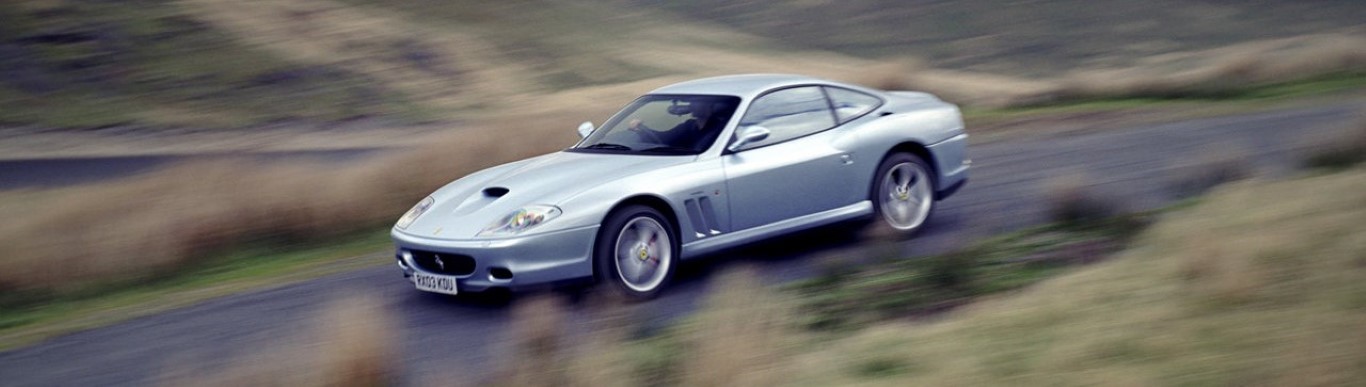
The "Modificata" philosophy manifested itself in every technical aspect of the car. Although the
silhouette designed by Pininfarina remained familiar, the improvements under the bodywork were profound,
redefining the performance and driving experience of a Ferrari Grand Tourer (GT).
'F133 E/G' V12 Engine and Performance
The heart of the 575M is its 65-degree V12 engine, which received special attention from the
Maranello engineers. The displacement was increased from 5474 cc to 5748 cc, not only to increase power, but
also to improve the torque curve and response across all rev ranges. The improvements included new intake
fluid dynamics, a higher compression ratio, and remapped electronic engine management (Bosch Motronic M 5.2)
to optimize efficiency.
The result was a power increase to 515 cv (or 508 hp) at 7,250 rpm and a maximum torque of 588 Nm at
5,250 rpm. These numbers translated into impressive performance for the time:
- Top speed: 325 km/h (202 mph).
- 0 to 100 km/h acceleration: 4.2 seconds with the F1 transmission and 4.25
seconds with the manual.
Transmission: The F1 Gearbox Revolution
The greatest technological innovation of the 575M was undoubtedly the introduction of the "F1"
automated manual transmission as an option, an absolute first for a road-going Ferrari V12. Based on a
6-speed manual gearbox by Graziano Trasmissioni, the system used electro-hydraulic actuators to perform gear
shifts in just 200 milliseconds, controlled by paddles behind the steering wheel. For comparison, a shift in
the manual gearbox took about 300 milliseconds.
This system also introduced "launch control" for the first time in a Ferrari production model, which
optimized acceleration from a standstill. Despite the innovation, Ferrari continued to offer the traditional
and beloved 6-speed manual gearbox with the gated shifter, although this option proved to be much less
popular among buyers.
Chassis, Suspension, and Brakes
To ensure the chassis could handle the increased performance, Ferrari implemented significant
improvements. The transaxle architecture, with the gearbox mounted on the rear axle, was retained to
preserve the ideal 50/50 weight distribution with the driver on board, a key factor for the car's balance
and drivability.
The big news was the introduction of a suspension system with adaptive damping. This system
independently controlled the stiffness of each of the four shock absorbers, continuously adjusting to road
conditions and driving style. The driver could choose between two main modes: "Sport", which stiffened the
suspension and sped up the F1 gearbox's gear shifts, and "Comfort", which prioritized a smoother, more
relaxed ride. The brakes were also upgraded, with larger diameter discs and new pads (Ferodo HP1000) that
offered greater stopping power and better fade resistance.
Design and Aerodynamics by Pininfarina
The design of the 550 Maranello, created by Lorenzo Ramaciotti at Pininfarina, was already considered
an instant classic, and Ferrari wisely decided not to alter it drastically. The modifications to the 575M
were subtle and mostly functional. The front end was redesigned with new air intakes and an optimized
spoiler to improve cooling and aerodynamic efficiency.
The headlights were modernized, featuring a body-colored housing and xenon technology as standard.
Small details, such as aerodynamic fairings added to smooth airflow around the wheels, demonstrated the
attention to detail in reducing drag. The interior was also significantly redesigned, with a new instrument
panel, more comfortable and ergonomic seats, and higher quality finishes, reinforcing its character as a
luxury Grand Tourer.