
1st Generation
(2007-2012)
6.0 V12
670 cv
Technical specifications, versions, and history for the Ferrari 599 GTB.
Select a generation to see available versions
(2007-2012)
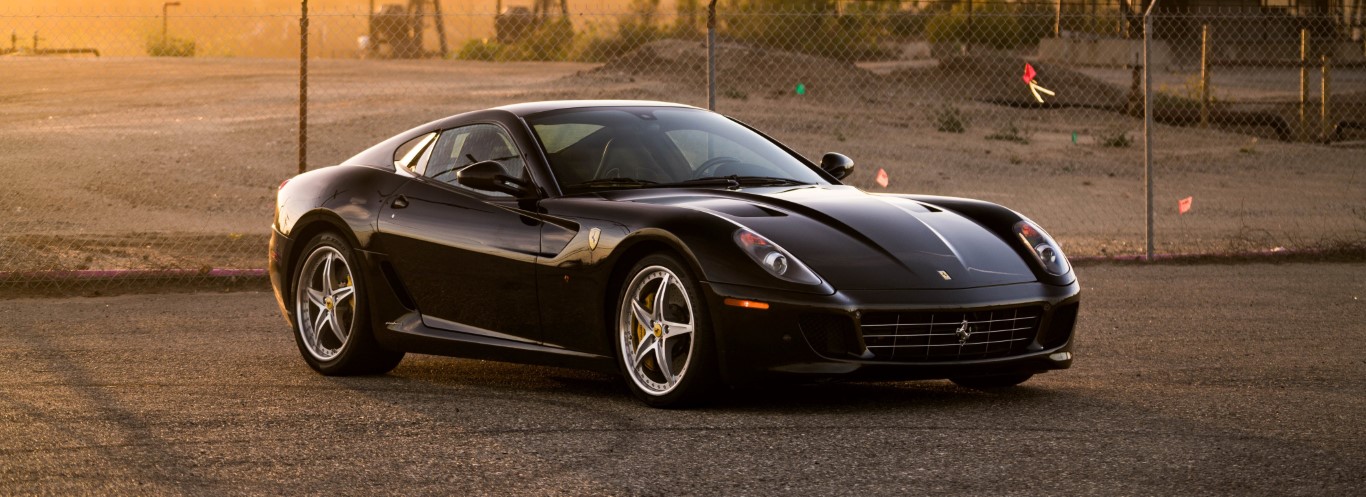
The Ferrari 599 GTB Fiorano, presented at the Geneva Motor Show in 2006 and produced between 2007 and 2012, was much more than the successor to the 575M Maranello. It represented a technological statement of intent, serving as a crucial bridge between Ferrari's more analog Grand Tourers and the era of modern supercars, packed with sophisticated electronics derived directly from Formula 1.
The project's objectives were clear and ambitious: to increase driving pleasure, guarantee overwhelming performance through the transfer of F1 technology, and simultaneously ensure high levels of comfort, ergonomics, and safety. The car's very name is a tribute to its heritage: "599" refers to the engine displacement of 5999 cm3, divided by 10; "GTB" stands for Gran Turismo Berlinetta, honoring the brand's most famous berlinettas; and "Fiorano" is the name of Ferrari's test circuit, where the car's performance was meticulously perfected.
However, the 599 was more than a single car; it was a versatile engineering platform that gave rise to a complete family of vehicles, from the luxurious street-legal Grand Tourer to an exclusive experimental track machine. Ferrari's strategy with the 599 demonstrated a remarkable maturation in its product philosophy. Instead of developing each version from scratch, the company established an extremely robust engineering base with the GTB model, designed with an evolutionary capacity that went far beyond the initial car. This allowed the creation of a true "ecosystem" around the model, where the track version (the 599XX) functioned as a research and development laboratory, whose innovations could be reintroduced into the street platform (the 599 GTO). This approach not only maximized the return on initial investment but also strengthened the brand's image by creating a clear and cohesive technological lineage.
The 599 GTB Fiorano set a new standard for front-engine Grand Tourers, combining stunning design, an engine inherited from a hypercar, and an arsenal of cutting-edge technologies.
The design of the 599, led by Jason Castriota at the Pininfarina studio, was a sculptural work of art, where every line and surface was carefully modeled to be both beautiful and functional. The car marked a significant advancement over its predecessor, the 575M, by utilizing an all-aluminum construction for the chassis and bodywork. This choice not only reduced weight but also allowed for an optimized weight distribution of 47% at the front and 53% at the rear, with the V12 engine positioned entirely behind the front axle.
The most striking and visually distinct aerodynamic innovation was the "flying buttresses". Instead of resorting to a large, intrusive rear wing, the designers created two arches that extended from the roof to the rear of the car, cleanly channeling the airflow over the bodywork. This ingenious solution generated significant downforce at high speeds, crucial for stability, without compromising the elegance and classic silhouette of a Grand Tourer. The design was complemented by a flat underbody and a prominent rear diffuser, which worked together to manage the airflow under the vehicle, ensuring that the 599 remained stable and predictable even at speeds exceeding 300 km/h.
The heart of the 599 GTB Fiorano was a version of the legendary 6.0-liter (5999 cm3) 65° V12 engine, with the internal code F140C, derived directly from the engine that powered the Ferrari Enzo hypercar. This strategic decision positioned the 599 at the absolute top of the GT segment, giving it an unprecedented pedigree and level of performance.
The engine produced an impressive 620 cv at 7,600 rpm and 608 Nm (61.9 kgfm) of torque at 5,600 rpm, with the maximum rotation reaching 8,400 rpm. At the time of its launch, it was one of the most powerful naturally aspirated engines in the world, with a remarkable specific output of 103.4 cv per liter. These numbers translated into overwhelming performance for a front-engine car: 0 to 100 km/h acceleration in just 3.7 seconds and a declared top speed exceeding 330 km/h.
The 599 GTB Fiorano wasn't just brute force; it was a milestone in the introduction of advanced electronic technologies derived from Formula 1 into a street-legal Ferrari.
These technologies, together, redefined expectations for the Grand Tourer segment. Before the 599, there was a clear distinction between mid-engine supercars, which were more agile and technological, and front-engine V12 GTs, focused on long-distance comfort. Ferrari broke this barrier by equipping the 599 with a hypercar engine and the house's most advanced electronics. The technology didn't just serve to increase performance, but to make it usable. Managing 620 cv with rear-wheel drive in 2006 was a challenge, but electronics made this power accessible to drivers who weren't professional racers. As a result, the 599 GTB became the benchmark, to the point of being used by Porsche as the target to beat during the development of the 911 GT2 RS, forcing competitors like Lamborghini and Aston Martin to evolve to keep up with the new standard.
| Category | Specification |
|---|---|
| Engine | |
| Type | 65° V12, Naturally Aspirated |
| Engine Code | F140C |
| Displacement | 5999 cm3 |
| Maximum Power | 620 cv @ 7,600 rpm |
| Maximum Torque | 608 Nm (61.9 kgfm) @ 5,600 rpm |
| Maximum RPM | 8,400 rpm |
| Compression Ratio | 11.2:1 |
| Fuel Delivery | Multipoint injection |
| Transmission | |
| Drivetrain | Rear-Wheel Drive (RWD) |
| Gearbox | 6-speed F1-SuperFast Automated / 6-speed Manual |
| Performance | |
| Top Speed | > 330 km/h |
| Acceleration 0-100 km/h | 3.7 s |
| Acceleration 0-200 km/h | 11.0 s |
| Chassis and Suspension | |
| Structure | Aluminum chassis and bodywork |
| Front Suspension | Overlapping arms, coil springs, SCM |
| Rear Suspension | Overlapping arms, coil springs, SCM |
| Brakes | Ventilated carbon-ceramic discs |
| Front Tires | 245/40 R19 |
| Rear Tires | 305/35 R20 |
| Dimensions and Weight | |
| Length | 4665 mm |
| Width | 1962 mm |
| Height | 1336 mm |
| Wheelbase | 2750 mm |
| Curb Weight | ~1690 kg |
| Weight Distribution | 47% Front / 53% Rear |
| Fuel Tank | 105 liters |
| Trunk Capacity | 320 liters |
The 599 platform proved to be the perfect base for a series of evolutions that catered to different market niches, from handling-focused enhancements to limited editions of extreme performance and unmatched exclusivity.
Launched in 2009, the HGTE (Handling Gran Turismo Evoluzione) package was a direct response to feedback that the standard 599 GTB, although incredibly competent, was a bit "soft" for the most purist and demanding drivers. The goal was clear: to improve handling, agility, and driver engagement, transforming the 599 into a sharper and more focused machine, without altering the engine's power.
The modifications were comprehensive and focused on the vehicle's dynamics:
Available as an optional package that could also be installed on existing cars (retrofit), it is believed that fewer than 500 units left the factory with the HGTE package, making it a desirable specification.
The GTO (Gran Turismo Omologato) name is sacred in Ferrari's history, previously used only on the legendary 250 GTO and the iconic 288 GTO. Its application to the 599 signaled the arrival of a street car with the soul and technology of a race car. The 599 GTO was, in essence, the street-homologated version of the experimental 599XX track car, transferring many of its innovations directly from the XX program.
The V12 engine was extensively reworked to produce 670 cv at 8,250 rpm, while the car's weight was reduced by about 100 kg compared to the standard GTB, resulting in an exceptional power-to-weight ratio of 2.22 kg/cv. Performance was next level: 0 to 100 km/h in 3.35 seconds, top speed exceeding 335 km/h, and a record lap time at Fiorano of 1 minute and 24 seconds, one second faster than the Ferrari Enzo.
Aerodynamics were drastically improved with a package derived from the 599XX, including a new front spoiler, a double-curvature rear diffuser, and "wheel doughnuts" — aerodynamic discs on the wheels to optimize airflow and brake cooling. These modifications generated 144 kg of downforce at 200 km/h, keeping the car glued to the asphalt. Production was strictly limited to 599 units, ensuring its exclusivity and collector status.
The 599 SA Aperta was created to celebrate the 80th anniversary of the prestigious Pininfarina design studio. The initials "SA" are a direct tribute to Sergio and Andrea Pininfarina, iconic figures who linked their company's name to Ferrari's most successful models.
This wasn't just a 599 convertible. It was a true roadster, with a lower, more raked windshield and two aerodynamic safety arches behind the seats that integrated perfectly into the design. To maintain focus on the open-air driving experience, the car came with only a lightweight emergency soft top, designed for temporary use and at low speeds.
Mechanically, the SA Aperta was an open-top GTO. It utilized the complete powertrain from the 599 GTO, including the powerful 670 cv V12 engine and the ultra-fast-shifting F1 gearbox. Performance was equally impressive, with a 0 to 100 km/h acceleration in 3.6 seconds and a top speed of 325 km/h. Production was limited to just 80 units, making the SA Aperta one of the rarest and most coveted modern-era Ferraris in the world.
The progression of the 599 family — from the GTB to the HGTE package and, finally, to the halo editions GTO and SA Aperta — represents a masterful case study in product lifecycle management. Ferrari launched the GTB as a very high-performance base product, but with the comfort of a GT. Then, listening to enthusiasts, it launched the HGTE package as a "mid-cycle" update to meet the demand for a more focused experience. Finally, the GTO and the SA Aperta represented the pinnacle of the lifecycle, creating top-tier products with strong narratives that solidified the platform's legacy. This strategy allowed Ferrari to keep the 599 model relevant and desirable throughout its entire production cycle, segmenting the market for different types of customers.
The XX Program represents the pinnacle of Ferrari engineering, creating vehicles that are not homologated for either the streets or official competitions, serving as rolling technology laboratories for a select group of clients.
The 599XX was not a conventional race car. It was a "laboratory car" designed for selected clients who, by participating in exclusive track events of the Corse Clienti program, acted as test drivers for Ferrari. The goal was to test cutting-edge technologies in an extreme environment, with real-time data collected being used to develop future street and F1 cars for the brand.
The 6.0-liter V12 engine was extensively reworked with lighter components, exotic materials such as carbon fiber in the intake plenums, and reduced internal friction. Power jumped to 730 cv, and the maximum rotation was raised to an impressive 9,000 rpm. The gearbox was recalibrated to perform shifts in just 60 milliseconds.
The most radical innovation, however, lay in aerodynamics. The "Actiflow" system utilized two fans mounted in the trunk that sucked air from beneath the car through a porous material diffuser, expelling it through the openings where the taillights would normally be. This allowed the system to dramatically increase downforce (generating up to 630 kg at 300 km/h) for maximum cornering grip, or reduce drag on straights for higher top speed. The result was overwhelming performance: the 599XX became the first production-derived car to break the 7-minute barrier on the legendary Nürburgring Nordschleife circuit, with a time of 6:58.16. It is believed that only 29 units were built.
The 599XX Evo was an upgrade package offered to 599XX owners, taking the laboratory car concept even further. The major innovation was the introduction of an F1-inspired active rear wing, equipped with a system similar to DRS (Drag Reduction System). Called the "opening gap," the system featured two flaps on the wing that could rotate to alter the aerodynamic profile. Electronically controlled based on speed, steering wheel angle, and lateral and longitudinal acceleration, the system optimized the downforce balance between the front and rear axles, drastically improving cornering performance. With the flaps closed, total downforce at 200 km/h reached 440 kg.
Power was also increased. With the adoption of side exhausts, the engine now delivered 750 cv and 700 Nm of torque. Combined with a shorter final gear ratio, the 599XX Evo was capable of completing a lap at Fiorano in just 1 minute and 15 seconds, a time comparable to that of GT category race cars.
The XX program, exemplified by the 599XX and its Evo version, reveals a brilliant business model. Instead of bearing 100% of the research and development costs of its most extreme technologies, Ferrari created a program where its most loyal and wealthy clients pay millions for the privilege of testing these prototypes. This not only generates positive cash flow for the R&D department but also provides valuable real-world data and creates a level of exclusivity and brand engagement that is unmatched. The technologies validated in the XX program, such as the Evo's active aerodynamics, became the foundation for systems found in future street cars like the LaFerrari and the F12tdf.
The history of the Ferrari 599 is also a story of exclusivity, with production numbers that vary drastically among its versions, culminating in one of the rarest manual cars of the modern era.
| Metric | 599 GTB Fiorano | 599 GTO | 599 SA Aperta | 599XX | 599XX Evo |
|---|---|---|---|---|---|
| Power (cv) | 620 @ 7,600 rpm | 670 @ 8,250 rpm | 670 @ 8,250 rpm | 730 @ 9,000 rpm | 750 @ 9,000 rpm |
| Torque (Nm) | 608 @ 5,600 rpm | 620 @ 6,500 rpm | 620 @ 6,500 rpm | 686 Nm | 700 Nm |
| Dry Weight (kg) | ~1,580 kg | ~1,495 kg | ~1,595 kg | 1,345 kg | 1,310 kg |
| Power/Weight Ratio | 2.55 kg/cv | 2.23 kg/cv | 2.38 kg/cv | 1.84 kg/cv | 1.75 kg/cv |
| 0-100 km/h (s) | 3.7 s | 3.35 s | 3.6 s | 2.9 s | N/A |
| Top Speed (km/h) | > 330 | > 335 | > 325 | 315 (limited) | N/A |
| Units Produced | ~3,500-4,000 | 599 | 80 | 29 | Upgrade package |
The production numbers of the 599 family tell a clear story of growing segmentation and exclusivity:
Besides these, there were other even rarer versions, such as the 60F1 special edition, which celebrated 60 years of Ferrari victories in F1, and the unique 599 HY-KERS prototype, a laboratory for the hybrid technology that would later be used in the LaFerrari.
Amidst a sea of cutting-edge technology, the 599 GTB Fiorano holds a historical distinction of great importance: it was the last V12 Ferrari to be offered with a six-speed manual transmission, complete with the iconic metal gated shifter.
The rarity of this configuration is striking. Only 30 manual examples were produced worldwide. Of these, 20 were destined for the United States market, and only 10 remained in Europe. This incredibly low number was not an accident, but rather a reflection of Ferrari's strategic shift toward automated F1 gearboxes, which offered objectively superior performance.
The production of only 30 manual units marks a turning point in Ferrari's philosophy. Historically, the manual gearbox was synonymous with sportiness and engagement. However, the brand's automated gearbox technology reached a point where it was demonstrably faster. For a brand built upon the pillar of maximum performance, continuing to offer a slower option became a contradiction. The manual 599 was, therefore, the "last call" for traditionalists, a historical artifact that marks the exact moment when the relentless pursuit of faster lap times permanently surpassed the tradition of mechanical engagement as the brand's core value. This makes it one of the most valuable and collectible modern-era Ferraris.
The Ferrari 599 wasn't just a successful model; it was a transformative engineering platform that redefined the Grand Tourer segment, served as a testbed for technologies that would shape the next decade of supercars, and produced some of the most desirable and collectible vehicles in modern Ferrari history.
It laid the technological and philosophical foundations for its successors, such as the F12berlinetta and the 812 Superfast. The sophisticated electronics, the focus on functional aerodynamics, and the strategy of creating a family of models around a single platform became the new standard for Ferrari. In essence, the 599 was the first V12 Ferrari of the 21st century, and its profound and lasting impact is still felt in the automotive industry today.