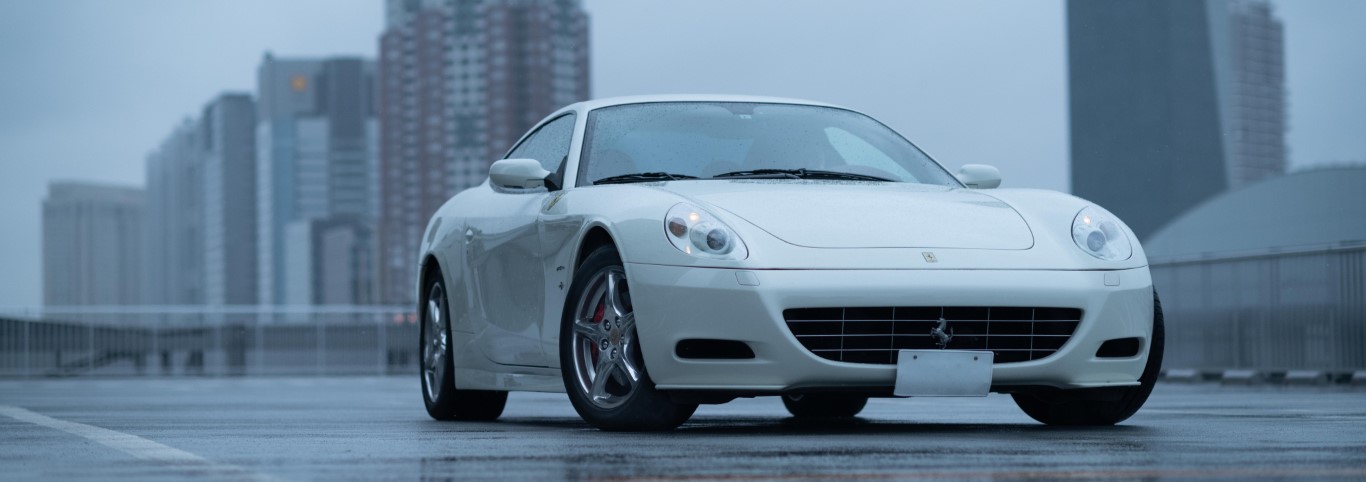
The design of the 612 Scaglietti represents a remarkable balance between Ferrari's stylistic heritage
and the application of cutting-edge engineering technologies for its time.
Exterior Styling by Pininfarina
The exterior design was conceived by the renowned Pininfarina studio, under the leadership of designer Ken
Okuyama. The primary inspiration for its fluid and muscular lines came from a unique and historic model: the
1954 Ferrari 375 MM, commissioned by acclaimed film director Roberto Rossellini as a gift for his wife,
actress Ingrid Bergman. The most direct homage to this iconic car are the sculpted side recesses, known as
"scallops," which give the 612 a distinct profile and timeless elegance.
Despite being the longest production Ferrari of its era, the design with short overhangs and a
generous wheelbase of 2,950 mm managed to maintain sporting proportions and a sense of agility. The bodywork
was almost entirely constructed of aluminum, with the exception of the bumpers and some covers made of
thermoplastic material.
The Luxury Cabin
The interior of the 612 Scaglietti was designed to fulfill the promise of being a true 2+2. The long
wheelbase allowed the creation of a genuinely spacious cabin for four adults, a substantial improvement over
its predecessor. Access to the rear seats was carefully thought out, with doors that opened to a wider angle
and an electric system that moved the front seats forward to facilitate entry and exit.
The internal environment was pure luxury, with extensive use of high-quality leather and aluminum
details on the dashboard, center console, and controls, reinforcing the connection with the noble material
that defined the car's structure. The instrument panel combined the best of both worlds: a large analog
tachometer in a central position, flanked by a speedometer on the right and a multifunctional digital screen
on the left, offering a clear and intuitive reading of vital information.
The Aluminum Structure
The foundation of the 612 Scaglietti was its advanced structure. It was the second Ferrari model, after the
360 Modena, to use a fully aluminum spaceframe chassis, developed in collaboration with the American company
Alcoa. Composed of aluminum extrusions and castings welded together, this structure offered torsional
rigidity far superior to that of the 456M and was about 60 kg lighter, despite the significant increase in
the car's dimensions.
The adoption of this technology, validated in the mid-engined 360 Modena supercar, was not just an
isolated technical improvement. It represented a strategic decision to unify Ferrari's cutting-edge
engineering platform, transferring the aluminum chassis technology to its line of front-engined grand
tourers. This not only resulted in a dynamically superior car but also reinforced Ferrari's image as an
avant-garde company across its entire product range.
To optimize driving dynamics, Ferrari implemented a front-mid engine configuration, positioning the
V12 behind the front axle, and a transaxle layout, with the gearbox mounted on the rear axle alongside the
differential. This complex architecture achieved an almost perfect weight distribution of 46% at the front
and 54% at the rear, a crucial factor for the agility, balance, and predictability of the car's behavior on
the road.