1st Generation
(2020-2025)
4.0 V8 Twin-turbo Phev
1030 cv
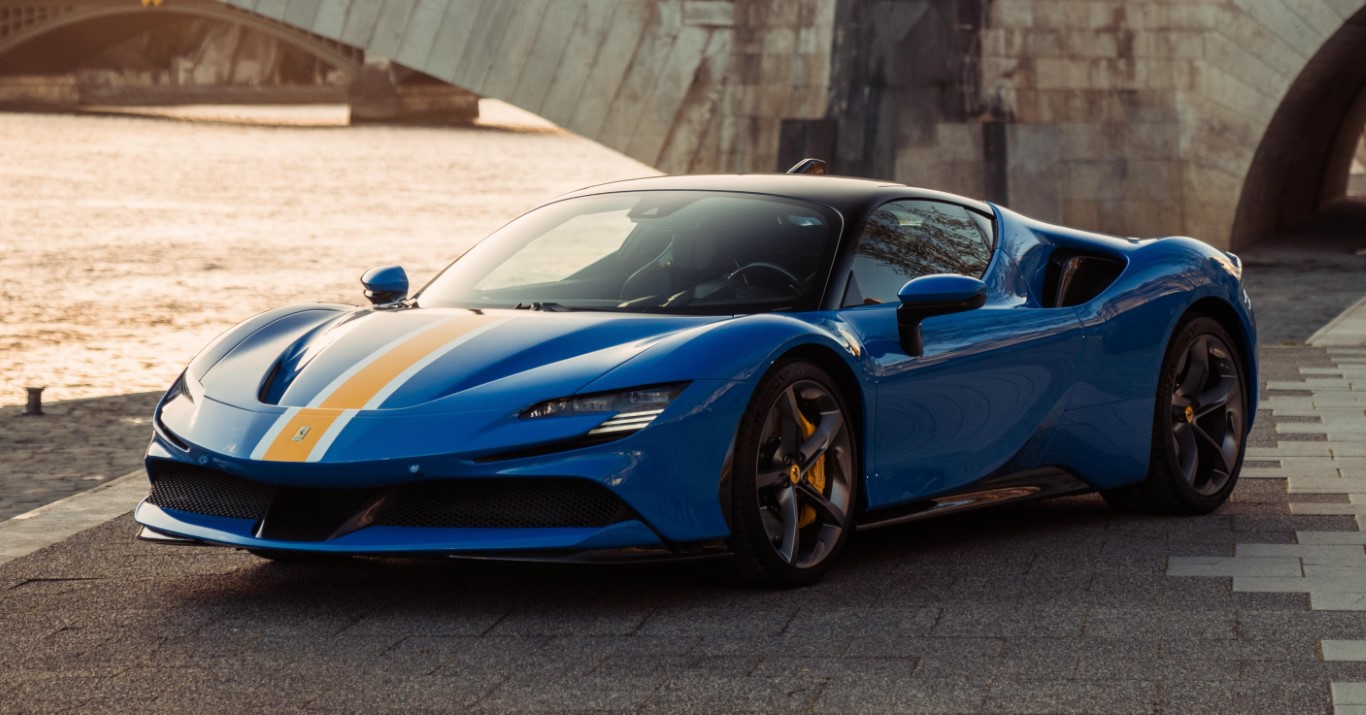
Limitless performance without a roof: the 1000 hp roadster that elevated the open-air concept to hypercar levels.
Select a generation to see available versions
(2020-2025)
The Ferrari SF90 represents one of the most transformative moments in the history of the Maranello manufacturer. Launched in 2019, it is not just another high-performance supercar, but a technological watershed that redefines the brand's future and sets new standards for the entire automotive industry. This report details the history, engineering, and different versions of this iconic model, exploring how Ferrari combined its rich racing heritage with the technology of the future.
The name of a Ferrari car is never chosen at random, and the SF90's is loaded with symbolism. The acronym "SF" stands for "Scuderia Ferrari", the brand's legendary racing team, while the number "90" celebrates the 90th anniversary of its founding by Enzo Ferrari in 1929. The suffix "Stradale", which means "road" in Italian, serves to differentiate this mass-produced model from its direct inspiration: the 2019 season Formula 1 car, also called SF90.
This naming choice was a brilliant strategic maneuver. Ferrari was about to introduce the most radical technology in one of its production cars: a plug-in hybrid (PHEV) system combined with all-wheel drive, a first for a mid-engine sports car from the brand. Historically, Ferrari's customer base values mechanical purity and tradition, especially naturally aspirated engines. Such a drastic change could meet resistance. By naming the car after the F1 team and celebrating the Scuderia's anniversary, Ferrari used its most powerful brand asset – its racing heritage – to validate and legitimize the new technology. The implicit message was clear: hybridization was not a deviation from Ferrari's identity, but rather the latest manifestation of its competitive spirit, transferred directly from the track to the streets.
The SF90 Stradale marked a paradigm shift for Ferrari by becoming its first series-production plug-in hybrid vehicle. Even more significantly, for the first time in the brand's history, a V8-powered car assumed the position of the top-of-the-range model in terms of performance, surpassing the traditional V12s. With a combined output of 1000 cv (cheval vapeur, or horsepower), the SF90 not only set a new performance standard for Ferrari but for the entire sports car sector, proving that electrification could be a tool for extreme performance.
The SF90's propulsion system is an engineering masterpiece that harmoniously integrates a V8 combustion engine with three electric motors, creating one of the most complex and powerful powertrains ever put into a street car.
At the center of the SF90 is an evolution of Ferrari's award-winning F154 engine. It is a 4.0-liter (3990 cm³) V8 with two turbochargers, mounted in a mid-rear longitudinal position. On its own, this combustion engine generates an impressive 780 cv (769 hp) at 7,500 rpm and 800 Nm (81.6 kgfm) of torque at 6,000 rpm, making it the most powerful V8 ever produced by Ferrari for a road car up to that point.
To achieve these numbers, Maranello's engineers completely redesigned the intake and exhaust systems. The cylinder heads were narrowed, new high-pressure fuel injectors (350 bar) were installed, and the entire engine assembly was mounted 50 mm lower in the chassis to optimize the center of gravity. The exhaust manifold is made of Inconel, a highly heat-resistant and very light nickel-chromium superalloy, a material derived directly from Formula 1.
Complementing the V8, the SF90 has three electric motors that together add 220 cv (162 kW) to the system. The distribution is as follows:
Power for these motors is supplied by a high-performance lithium-ion battery with a capacity of 7.9 kWh. This battery allows the SF90 to have a pure electric range of up to 25 km, with a maximum speed of 135 km/h using only the electric motors.
The synergy between the combustion engine and the three electric motors results in a total combined output of 1000 cv (986 hp). The combined torque of the system is 800 Nm, with the V8 engine being the main contributor.
All this power is managed by a new 8-speed dual-clutch gearbox (F1 DCT) developed by Magna. This transmission is 10 kg lighter and more compact than the previous 7-speed used in other Ferrari models. One of its most notable features is the absence of a dedicated reverse gear.
This absence is not a flaw, but rather the result of causal integration engineering. The decision to use two electric motors on the front axle was not just to add power or create all-wheel drive; it was a choice that generated a cascade of benefits. By delegating the reverse gear function to the front electric motors, engineers were able to eliminate the heavy and complex reverse mechanism from the main gearbox. This resulted in a lighter and more compact transmission, which in turn allowed the entire powertrain assembly to be mounted lower in the chassis, contributing to a lower center of gravity and thereby improving the vehicle's dynamics. Electric all-wheel drive, therefore, is not just a performance system, but a key piece in a chain of engineering decisions that optimizes the car's weight, layout, and agility in an integrated way.
To manage the complexity of the hybrid powertrain, Ferrari introduced the eManettino, an additional selector on the steering wheel with four driving modes:
Vehicle dynamics are enhanced by the on-demand all-wheel drive (e4WD). The front motors enable the RAC-e (electronic rotational axis control / Regulator of Cornering Angle, Electric) system, which performs torque vectoring precisely, independently controlling the power sent to the inner and outer wheel in a corner. This drastically improves traction coming out of corners and makes the car incredibly agile. The entire system is managed by the eSSC (electronic Side Slip Control), which monitors and adjusts the vehicle's stability in real time.
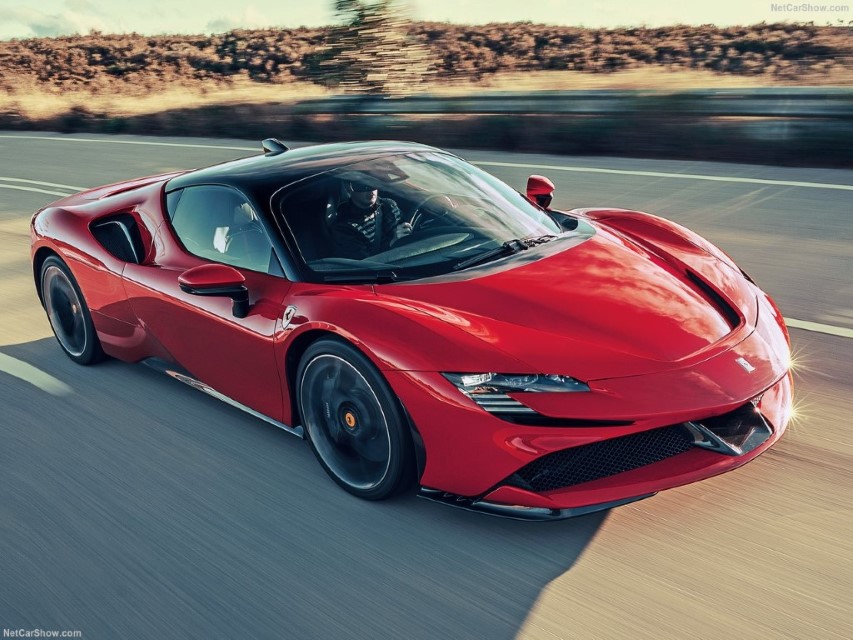
The coupe version, the SF90 Stradale, was the first model in the family to be presented, establishing the foundations of design, aerodynamics, and performance that would define the entire line.
The design of the SF90 Stradale adopts a "cab-forward" approach, which shifts the cockpit forward to optimize airflow over the bodywork. The proportions have been completely revised compared to Ferrari's previous mid-rear-engined berlinettas, resulting in a lower and more aggressive silhouette, with the rear dominated by high-mounted exhaust pipes.
The most innovative aerodynamic element is the "shut-off Gurney", a patented active system at the rear. Instead of a conventional wing that rises, a movable section of the bodywork lowers to expose a Gurney flap, which drastically alters the airflow. The system operates in two modes:
This system represents a philosophy of "aerodynamics on demand". Traditional supercars face a dilemma: a large fixed wing generates downforce, but also creates constant drag, which hinders top speed. The SF90's shut-off Gurney is a smarter and faster solution. It allows the car to maintain a "clean" aerodynamic profile most of the time, optimizing its top speed of 340 km/h, and only generates massive downforce the instant the car's dynamics require more grip.
The performance numbers of the SF90 Stradale are impressive:
The interior of the SF90 was designed based on the "eyes on the road, hands on the wheel" philosophy derived from Ferrari's racing experience. The steering wheel is the control center, with a touchpad and haptic buttons that allow the driver to operate almost all of the car's functions without taking their hands off it. The traditional instrument panel was replaced by a single 16-inch curved HD screen, fully digital and configurable. On the center console, the automatic gear selector has a gate design that recalls Ferrari's iconic manual gearboxes, a tribute to tradition amidst so much technology.
For customers who desire the thrill of open-air driving without compromising performance, Ferrari launched the SF90 Spider, the convertible version of its hybrid hypercar.
The Spider's main feature is its Retractable Hard Top (RHT). The mechanism, a Ferrari specialty, opens or closes in just 14 seconds and can be operated with the car moving at speeds of up to 45 km/h. The system is remarkably compact, taking up only 100 liters of space, compared to the 150-200 liters of traditional systems. This was made possible thanks to a clever redesign of the separation line between the roof and the bodywork. A crucial detail for brand purists is that the design allows the V8 engine to remain visible through the glass engine cover, even when the roof is stowed.
The addition of the roof mechanism and the structural reinforcements needed to maintain chassis rigidity results in an increase in weight. The SF90 Spider has a dry weight of 1670 kg, approximately 100 kg more than the Stradale.
Despite the extra weight, the Spider's performance is virtually identical to that of the coupe. Acceleration from 0 to 100 km/h is maintained at the same 2.5 seconds, while the 0 to 200 km/h time is only slightly slower, at 7.0 seconds. Top speed remains unchanged at 340 km/h. The ability to maintain the 0-100 km/h time, even with an extra 100 kg, demonstrates that the limiting factor for initial acceleration is not power, but rather traction. The all-wheel drive system and the instantaneous torque delivery of the electric motors already push the tires to their absolute limit of grip. The 1000 cv powertrain has so much "spare" performance that it can compensate for the additional weight with no penalty off the line, a testament to the magnitude of the available force.
It is important to note that the Assetto Fiorano is not a distinct model, but rather an equipment package that enhances the car's capabilities for track use. The name is a direct homage to Ferrari's private test circuit, the Pista di Fiorano, where the brand's cars are developed and pushed to the limit.
The Assetto Fiorano package includes a series of improvements focused on suspension, weight reduction, aerodynamics, and tires:
Offering the Assetto Fiorano package is a strategic decision that allows Ferrari to segment its audience. The brand recognizes that the hypercar market is not homogeneous. There is the customer who desires maximum performance with comfort for daily use, who will opt for the standard SF90. And there is the "track day" enthusiast, who values lap times above all else and is willing to sacrifice the comfort of adaptive dampers for a purer, more focused connection with the car. The Assetto Fiorano package allows Ferrari to cater to these two distinct profiles with a single base model, maximizing its market appeal.
When the performance of the SF90 Stradale with the Assetto Fiorano package seemed to be the limit, Ferrari raised the bar even higher with the XX Stradale and XX Spider versions, limited-edition models that bring track performance to the streets.
The XX versions represent a milestone: they are the first cars from Ferrari's exclusive "XX Program" to be homologated for public road use. Historically, the XX Program offered a select group of clients extreme performance cars, not street-legal, to be used only at track events organized by Ferrari itself. The SF90 XX Stradale and the XX Spider break this barrier, bringing this philosophy of uncompromised performance to the road.
The hybrid powertrain was upgraded to deliver even more performance.
The look of the XX versions is unmistakably more aggressive, with modifications focused on maximizing aerodynamic performance.
The extreme focus on track performance resulted in impressive numbers and some counter-intuitive engineering choices.
The reduction in top speed illustrates the "performance paradox". Intuitively, the most extreme model should be the fastest in all aspects. However, the lower top speed is not a flaw, but a deliberate choice that reveals the car's true purpose. The fixed wing and aggressive aerodynamics were designed for a single metric: the fastest possible lap time on a circuit. The massive downforce that "glues" the car to the asphalt in corners and under braking also creates significant aerodynamic drag, which limits straight-line speed. Ferrari consciously sacrificed the "top speed" metric, which has great marketing appeal, in favor of true track performance, a clear sign that the XX line is made up of purist race cars for the street.
The production strategy for the SF90 line clearly differentiates series models from collector's special editions, solidifying the car's legacy in distinct ways.
All units of the XX versions were sold to selected customers even before production began, highlighting the huge demand for these special models.
The table below consolidates the main technical specifications of all variants of the Ferrari SF90, allowing for a direct comparison.
| Feature | SF90 Stradale | SF90 Spider | SF90 XX Stradale | SF90 XX Spider |
|---|---|---|---|---|
| Combined Power | 1000 cv | 1000 cv | 1030 cv | 1030 cv |
| V8 Power | 780 cv | 780 cv | 797 cv | 797 cv |
| V8 Torque | 800 Nm | 800 Nm | 804 Nm | 804 Nm |
| 0-100 km/h | 2.5 s | 2.5 s | 2.3 s | 2.3 s |
| 0-200 km/h | 6.7 s | 7.0 s | 6.5 s | 6.7 s |
| Top Speed | 340 km/h | 340 km/h | 320 km/h | 320 km/h |
| Dry Weight | 1570 kg | 1670 kg | 1560 kg | 1660 kg |
| Key Aerodynamics | Shut-off Gurney | Shut-off Gurney | Fixed Rear Wing | Fixed Rear Wing |
| Downforce (at 250km/h) | 390 kg | 390 kg | 530 kg | 530 kg |
| Units Produced | Series Production | Series Production | 799 | 599 |
The impact of the Ferrari SF90 on the automotive industry is profound and lasting. It has conclusively proven that hybrid technology, when applied with Ferrari's philosophy, is a tool to elevate performance to never-before-seen levels, and not just a means to achieve efficiency and emissions targets.
The SF90 solidified Ferrari's transition to an electrified future, paving the way for subsequent models that also adopted hybridization, such as the 296 GTB. More importantly, it redefined what is expected of a modern hypercar. By combining overwhelming power with advanced traction systems, torque vectoring, and active aerodynamics, the SF90 made its 1000 cv surprisingly accessible and controllable, proving that maximum performance does not have to be intimidating. It is not just the car that led Ferrari into the hybrid era; it is the car that showed the world how the soul of a supercar can thrive in this new era.