1st Generation
(2019 - 2023)
Technical specifications, versions, and history for the Ford Territory.
Select a generation to see available versions
(2019 - 2023)
(2023 - 2025)
(2026-)
Select a powertrain to view full technical specifications
The trajectory of the Ford Territory in the global automotive industry represents an inflection point in the Ford Motor Company's industrial strategy, symbolizing the transition from a brand focused on unified global platforms to an agile regional collaboration approach. Unlike the homonymous model produced in Australia between 2004 and 2016, which was based on the Ford Falcon architecture, the Chinese-origin Ford Territory was born from a pressing need for competitiveness in the world's largest automotive market. This report details the technical, commercial, and historical trajectory of this mid-size SUV, analyzing its conception, intergenerational transformations, and its role in sustaining the Ford brand in emerging markets.
The history of the Chinese Ford Territory is intrinsically linked to the joint venture between Ford and the Jiangling Motors Corporation (JMC). In the late 2010s, Ford faced a sharp decline in its sales in China and lacked a mid-size SUV that was financially accessible for middle-class families in second and third-tier cities. The development of an entirely new platform from the American or European headquarters would have a prohibitive cost and a maturation time incompatible with the market's urgency.
The solution found was the "rebadging" and technical refinement of an existing JMC product: the Yusheng S330. The Yusheng S330 was a compact SUV launched in 2016, which already had a solid structure, but lacked the aesthetic and dynamic refinement expected of a product with the blue oval badge. The S330's original design had roots in the Landwind X7, a vehicle that became globally known for its visual resemblance to the Range Rover Evoque. Ford, holding a 32% stake in JMC, intervened in the project to apply its global standards of quality, safety, and design.
This strategy, although criticized by brand purists as a desperate measure, allowed Ford to quickly fill the gap between the EcoSport and the Edge. Ford's engineering worked exhaustively on suspension calibration, acoustic insulation (NVH), and the complete restyling of the front end and interior to ensure that the Territory was not just a JMC with another emblem, but a vehicle that delivered the brand's driving experience.
Officially launched in late 2018 in China, the first Ford Territory (codenamed CX743) laid the foundation for the brand's expansion into Latin America and Southeast Asia. The vehicle was positioned as a technology and interior space-focused SUV, offering dimensions that placed it at the top of its price category.
The first generation utilized a unibody structure with four-wheel independent suspension, featuring MacPherson struts at the front and a multi-link system at the rear. This configuration was an important differentiator, as many low-cost Chinese competitors still used a torsion beam axle at the rear.
| Attribute | 1st Generation Specification (CX743) |
|---|---|
| Length | 4,580 mm |
| Width | 1,936 mm |
| Height | 1,674 mm |
| Wheelbase | 2,716 mm |
| Trunk capacity | 420 to 1,120 liters |
| Curb weight | 1,520 kg to 1,635 kg |
The heart of the first generation was the 1.5 Turbo engine, developed by JMC with technical support from Ford and the Austrian consultancy AVL. This engine used the Miller cycle, a variation of the Otto cycle that prioritizes fuel efficiency and emission reduction, although it presents a more linear and less explosive power delivery.
Below are details on the engine options available for this phase of the model:
In 2019, Ford launched the Territory EV in China, its first fully electric vehicle in that market. This model was a key piece for the brand to meet the strict emissions targets of the Chinese government. The EV maintained the same chassis but replaced the combustion engine with a permanent magnet synchronous motor on the front axle.
| Technical Specification | Ford Territory EV (China) |
|---|---|
| Motor Power | 120 kW (163 hp) |
| Maximum Torque | 280 Nm |
| Battery Capacity | 49.14 kWh or 60.4 kWh (later versions) |
| Range (NEDC) | 360 km to 435 km |
| Charging Time (Fast 30-80%) | ~32 minutes |
| Top Speed | 150 km/h |
Visually, the Territory EV distinguished itself with a closed front grille featuring an exclusive hexagonal pattern and more pronounced "C"-shaped daytime running lights. Inside, the gear selector was replaced by a rotary dial, and the instrument cluster gained specific graphics for energy monitoring.
The second generation of the Ford Territory marked a fundamental shift in product philosophy. While the first model was a quick adaptation of a JMC design, the second generation was conceived from the beginning as a global Ford product, although still manufactured by the JMC-Ford joint venture in Nanchang.
In China, this vehicle is sold under the name Ford Equator Sport (or Lǐngruì), being a two-row seating version based on the larger Ford Equator platform. Development was led by Ford Australia's design and engineering teams, ensuring the vehicle aligned with the brand's new global visual language, seen in models like the Ford Explorer and the Mustang Mach-E.
The new model grew in almost all dimensions, offering one of the largest rear-seat legroom spaces in its category, which became its main selling point in Brazil and the Middle East.
| Dimension | Ford Territory / Equator Sport | Comparison with 1st Generation |
|---|---|---|
| Length | 4,630 mm | +50 mm |
| Width | 1,935 mm | Similar |
| Height | 1,706 mm | +32 mm |
| Wheelbase | 2,726 mm | +10 mm |
| Trunk | 448 to 1,422 liters | Significant increase |
One of the most celebrated changes in the second generation was the replacement of the CVT transmission with a 7-speed dual-clutch automatic gearbox (DCT) with wet clutches. This transmission, produced by Magna, provided a much more dynamic and efficient drive, eliminating the rubber-band effect of the previous model.
The engine was also updated to a new family of JMC-Ford turbocharged units:
This 1.8T engine, although sharing the EcoBoost name, has no direct relationship with the American engines of the Focus or Fusion line, being a JX4 family unit developed specifically for the Chinese operation, but validated under Ford's global rigors.
In mid-2024, with global expansion planned for 2025 and 2026, Ford presented a mid-life update for the second generation. The goal of this facelift was to align the SUV with the latest design trends and introduce plug-in hybrid (PHEV) technologies to compete with the new wave of electrified Chinese SUVs.
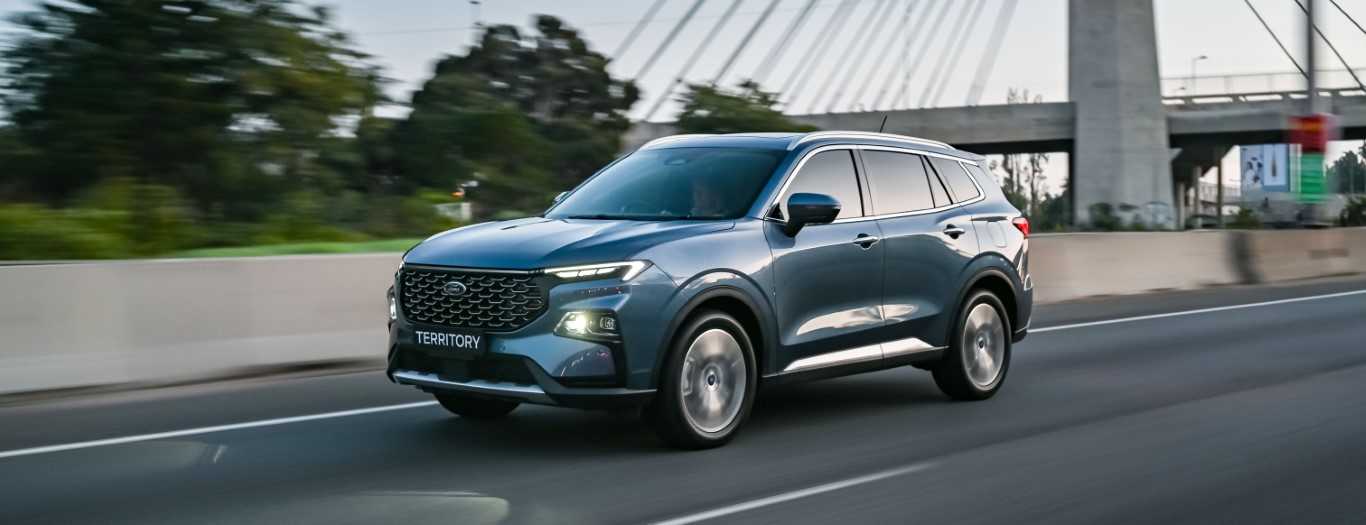
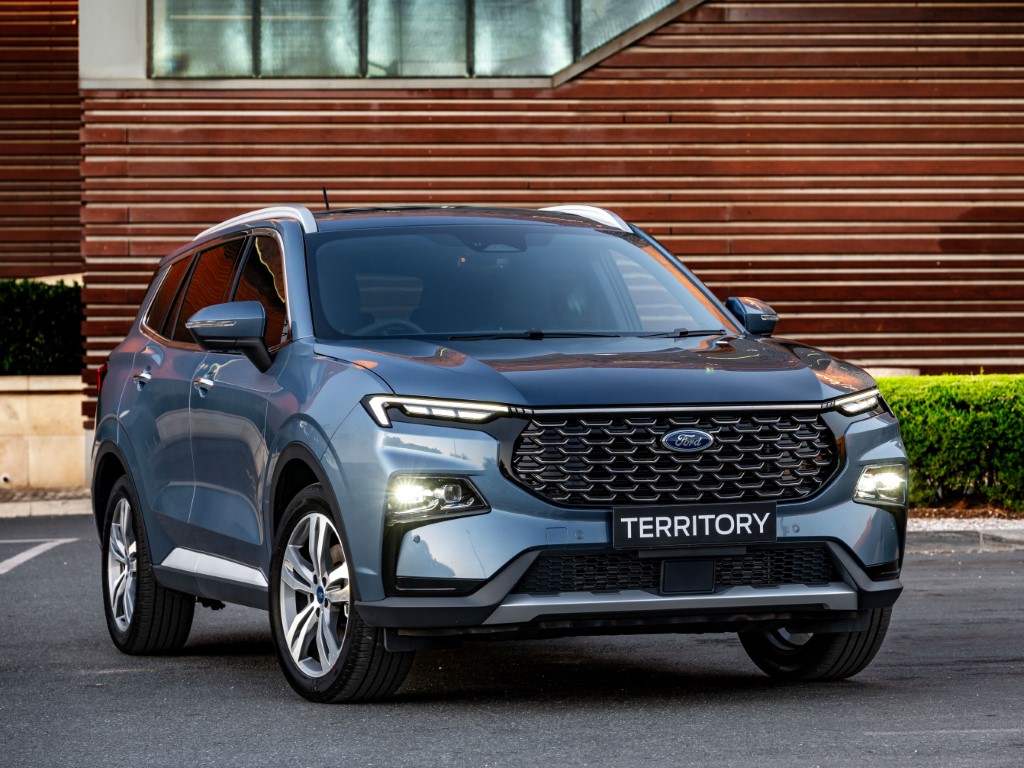
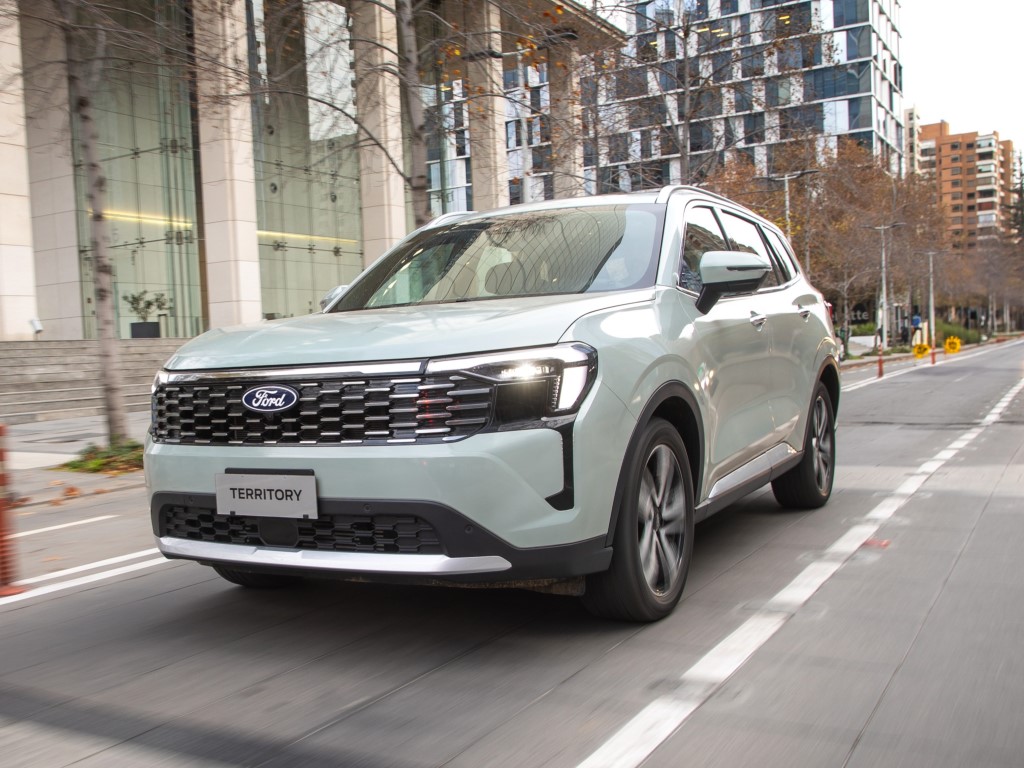
The most striking visual change occurs in the front section. The grille, which previously had a more traditional shape, now seamlessly integrates into the bumper, adopting a black scale pattern with chrome details, reminiscent of the design of the new Toyota Corolla Cross. The main headlights have been repositioned and have gained an inverted "L" shape, using adaptive Full-LED technology in some versions.
Inside, Ford has improved the trim materials, introducing soft-touch surfaces in more areas of the dashboard and doors. The technological system also received an upgrade:
The introduction of the PHEV version is the most important milestone of this phase. This system combines the efficiency of the 1.5 Turbo engine with the power of an electric motor fed by high-capacity batteries.
| PHEV System Component | Specification |
|---|---|
| Combustion Engine | 1.5 Turbo (Miller Cycle) with 150 hp |
| Electric Motor | 60 kW (82 hp) |
| Combined Power | 218 hp |
| Combined Torque | > 30.6 kgfm (300 Nm) |
| Pure Electric Range | 50 km to 70 km |
| Estimated Average Consumption | Up to 40 km/l (2.5 L/100 km) |
The transmission for this hybrid version is a dedicated 2-speed unit (DHT), optimized to manage the combined torque delivery smoothly.
The Ford Territory has been one of the vehicles responsible for democratizing the Co-Pilot360 active safety package in emerging markets. Throughout the generations, the sensors and algorithms have evolved to offer safer and less stressful driving.
The main features integrated into the top-of-the-line versions (Titanium and Titanium X) include:
In the 2025/2026 version, the system was updated to include Traffic Jam Assistant, which combines ACC and lane keeping to drive the vehicle almost autonomously in low-speed traffic jams.
The Ford Territory is an export phenomenon. Although China was the launch market, the saturation of local EV brands caused domestic sales volume to drop from nearly 48,000 units in 2019 to about 1,600 in 2023. However, Ford redirected excess production capacity for export, where the SUV found enormous success.
Territory manufacturing is decentralized to meet global demand, using the SKD (Semi-Knocked Down) kit model in some countries.
| Country of Production | Assembly Plant | Markets Served |
|---|---|---|
| China | Nanchang (JMC-Ford) | China, Americas, Middle East |
| Vietnam | Hai Duong (Ford Vietnam) | Southeast Asia |
| Taiwan | Zhongli (Ford Lio Ho) | Local Market (Taiwan) |
In Brazil, the Ford Territory had a timid start in 2020 due to the devaluation of the Real and initial distrust about its Chinese origin. However, the launch of the second generation in 2023 drastically changed this scenario. In August 2025, the SUV reached a record 1,228 monthly registrations, a 35% growth compared to the previous year.
| Year | Sales in Brazil (Units) | Model Status |
|---|---|---|
| 2020 | 1,512 | Launch (1st Gen) |
| 2021 | 2,232 | Consolidation |
| 2022 | 976 | Generation Transition |
| 2023 | 1,324 | Arrival of the 2nd Gen |
| 2024 | 5,630 | Market Expansion |
| 2025 (Jan-Nov) | 7,700+ | Growth Leader (55%) |
Currently, the Territory is Ford's second most important vehicle in Brazil, behind only the Ranger and surpassing the Bronco Sport in sales volume. In the Argentine market, the performance is even more impressive, with the Territory occupying the 4th position in the overall sales ranking in February 2026, with a growth of 222.9% over the previous year.
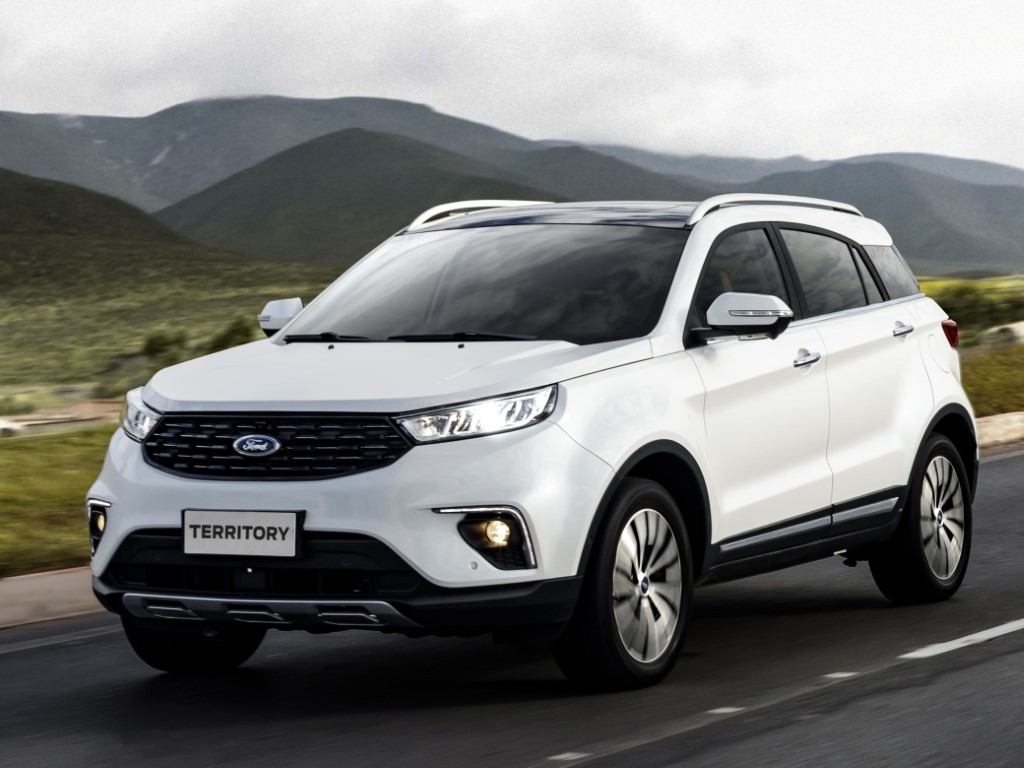
The evolution of the Territory reflects the change in global consumer taste. The first generation had a more conservative design, with many chrome elements and a dashboard that mixed physical buttons with a recessed central screen. The finish used many hard plastics, common in Chinese SUVs of 2018.
With the second generation and the subsequent facelift, Ford raised the level of sophistication:
The Ford Territory (Chinese) is more than an SUV; it is a symbol of survival and adaptation. It proved that Ford can compete in the volume segment in emerging markets by combining Chinese productive efficiency with Western engineering rigor.
The trajectory of the generations shows a clear maturation:
With its continuous expansion into new markets like South Africa and the Middle East, the Territory has become Ford's "Global SUV" for countries where the production cost of European or American models would be prohibitive, ensuring profitability and brand presence in geographical regions vital to the company's long-term strategy.
Images of the Ford Territory